Showing posts with label Sikkim Urja dam. Show all posts

Saturday, March 22, 2025

Updated satellite images of Oct 2023 GLOF affected areas from Google Earth

Google Earth has recently (Jan2025) made available high resolution images of some areas of North Sikkim which reveal the devastating impact of the Glacial Lake Outburst Flood (GLOF) of Oct2023 in North Sikkim. The images below juxtapose the affected areas with historical snapshots, illustrating the catastrophic consequences of the GLOF.

Chungthang town / confluence of the Lachen and Lachung Chu

Chungthang (elevation 1790m/5870', 27.62°N 88.63°E), a town in North Sikkim, is situated at the confluence of the Lachen Chu and Lachung Chu rivers, which merge to form the Teesta river.
On October 3, 2023, an avalanche triggered a GLOF in South Lhonak glacial lake (elevation 5200m/17000'), approximately 75km upstream from Chungthang along the Lachen Chu. The resulting sudden release of around 50 million cubic meters of water made it the largest GLOF in the Himalayas in recent history.
For a detailed account of this event, refer to this publication in Science magazine
STH has closely documented the Teesta valley GLOF of Oct2023 in this blog from the date of occurrence.
Satellite images along with photos of the affected areas are placed below:-

Chungthang town (close up)

Chungthang town (Dec2024)
The still devastated playground and army camp area is seen at the center with the gilded dome of the Gurudwara towards the right side.
Chungthang town playground on 19Nov2023 when we visited the area.

The 1200mw Sikkim - Urja dam and bridge at Chungthang

This was the largest dam in Sikkim and was located downstream of the confluence of the Lachen and Lachung Chu rivers. The 60m rockfill, run of the river dam was commissioned in Feb 20217 at a cost of Rs 14,000crores. Along with the dam, a major bridge (centre top of photo) connecting Chungthang to the rest of Sikkim was also destroyed by the GLOF.
The remnants of Sikkim Urja dam which collapsed in the GLOF on 04Oct2023. Photographed on 18Nov2023, when we visited Chungthang.
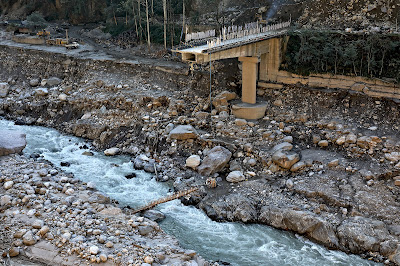
A double laned concrete bridge connecting Chungthang to the rest of Sikkim was destroyed by the GLOF here on 04Oct2023

Munshithang (27.6324° N 88.6157° E)

Munshithang, an ammo depot for the Indian army was totally destroyed by the 04Oct Teesta Valley GLOF. On receiving warning of the rising waters in the Lachen Chu, 92 personnel of the ammo depot moved to  higher ground and thus their lives were saved. However, it was 4 days before they could be evacuated - due to bad weather which prevented helicopter flights.
Nothing could be retrieved of the ammunition and equipment lost to the GLOF.

Toong bridge over the Teesta river  (27°33'0.15"N 88°38'35.17"E)

We visited this area on 19Nov2023 and photographed the bridge and the Toong checkpost both of which were destroyed by the GLOF (below)

There was only a small bamboo bridge across the Teesta for pedestrians to cross the river on foot in Nov2023
The Toong police checkpost had been vacated and dangled precariously from the edge of the road
Another view of the vacated police checkpost in Nov2023
Faced with the sheer necessity of communicating, the local community start constructing a wooden bridge across the Teesta at Toong.

 Naga Gram Panchayat (Mangan district, North Sikkim)

Naga GP is located approx 14km from Mangan (district HQ of N Sikkim district) towards Toong and was one of the worst affected areas when we visited Chungthang on 19Nov2023.

It continues to be a wrecked and desolate place as can be seen from the recent photos (of Dec2024) below (photo credits: Rinchen Lama, IIHS ,Bangalore)
Google Earth has unfortunately not updated satellite images of areas south of Naga area (North Sikkim) which are still of 2022 vintage as such they do not show the impact of the GLOF in these areas.


Praful Rao
SaveTheHills
savethehills@gmail.com
9475033744

Friday, October 4, 2024

Commemorating the 'Teesta Valley GLOF of 04Oct2023' with photos of the event and its aftermath.

A woman washes the money she recovered while scavenging for lost property in a flood affected area of Rangpo (Sikkim) on 06Oct2023 - photo credit Praveen

As I write, it is very early morning on 04Oct2024 and it was exactly at this time last year that I was up at my home in Kalimpong, trying to contact and verify with people, mainly in Sikkim, about whether a GLOF had actually taken place in the Teesta valley.
In the meantime my cellphone was receiving images and videos of the floods as the wall of water tore down the valley. Just verifying what was happening in order to report and record it accurately  kept me engaged the entire day and next, while my young friend and photographer Praveen Chhetri visited Teesta Bazar which the GLOF hit around 4am. He recorded the impact of the GLOF as it happened.
I did not know then that this process of recording the GLOF and its impact would keep us busy for an entire year but it has - and has required numerous visits to many parts of the Teesta valley including one trip made in Nov2023 to Chungthang where the 1200mw Sikkim Urja hydroelectric dam was destroyed by the GLOF.
What we have in this blog is perhaps the most comprehensive photographic record of what was the largest GLOF which took place in the Himalayas. Praveen and I certainly have hundreds of images, many videos and voice recordings of the interviews of affected people that we did during the course of the year.

    Interviewing an affected person who had lost everything to the GLOF - Rangpo (Sikkim), 06Oct2023.

This post, where I publish some photos is only to commemorate that momentous event which changed the lives of so many
Lest we forget...

Army personnel recovering buried vehicles at Bardang (Sikkim) on 06Oct2023. 22 army persons who were a part of a convoy were swept away by the GLOF here
Landslide affected areas of Naga, a village between Mangan(district headquarters, North Sikkim) and Chungthang in Nov2023 (telephoto image from opposite hill). The village was almost entirely evacuated during the monsoons of 2024.
A man crosses the Teesta river on a bamboo bridge at Toong, North Sikkim in Nov2023. The bridge connecting Chunthang to Mangan was torn down by the GLOF
GLOF affected areas between Chungthang and Lachen town where there was no impact of the Sikkim Urja dam burst. The scale of the devastation caused by the GLOF alone is apparent in the photo - photo courtesy Dathup, Lachen.
GLOF eroded parts of NH10 between Teesta bazar and Melli in Oct 2023. With the Teesta river running 4-5m above the pre-GLOF levels, the erosion of NH10 increased remarkably in 2024.
Debris and vegetation which the GLOF had dumped on top of the NHPC Stage V 510MW dam at Dikchu, SIkkim. The Teesta river 'over toppled ' ie went over the dam at this site.
Tree stumps and debris inside the NHPC Stage VI dam at Sirwani, Singtam (Sikkim), Nov2023
Vehicles strewn around like battered toys, on the banks of the Teesta at Singtam (Sikkim).
Part of Teesta town (Krishnagram or Bhasuwa) literally sliding slowly into the river - Sep2024
A marooned COVID hospital on the banks of the Teesta and Rangeet rivers at Tribeni, (Darjeeling district) - Sep2024. There is no road access to the hospital with the Teesta river having kept large parts of the access road submerged after the GLOF.
Rangpo town in Sept24. One year after the GLOF, parts of the town are still trying to recover. The river still flows uncomfortably close to the town and the police checkpost (green roofed structure on the top left is literally tilting into the river.
Undoubtedly one of the most iconic images of a GLOF.
Drone image taken by Praveen at around 11.00am on 04Oct2023 from the Teesta bridge when the GLOF was passing thru the area. As can be seen much of the Teesta bazar was already submerged.

Documentation of parts of the above report was supported by Royal Enfield, as part of their Social Mission Initiative


With
Praveen Chhetri (9733185815)

Praful Rao
SaveTheHills
9475033744
savethehills@gmail.com


Wednesday, January 24, 2024

AFTER THE FLOOD - By Pemzang Tenzin (Mangan, North Sikkim)


Zanak, at the base of the aptly named Sentinel Peak, is the last outpost on the lesser used but religiously and historically important Chorten Nyima La route to Tibet.  The ITBP personnel stationed there first raised the alarm on the South Lhonak Glacial Lake Outburst Flood (GLOF) and possibly saved the lives of many people in the path of the ravaging flood.

 South Lhonak Lake, like many other glacial lakes, is meltwater stored behind a fragile dam created by debris and ice left behind by the snout of the retreating glacier.   The 1950 Swiss Foundation map of Sikkim, based on earlier Government of India surveys and still used today by trekkers and mountaineers, does not show a lake at this location.  The lake has grown from nothing to its present dimensions of more than 200 standard football pitches within a span of less than a hundred years.  The glacier is expected to recede further and the size of the lake will increase in the very near future. The volume of water stored is thirteen times the storage of the erstwhile Teesta Urja reservoir.  It is estimated that half this volume spilled out during the October GLOF event.

This is a story repeated again and again in others parts of the high mountains as the ice cap starts melting at an accelerating rate due to the effects of climate warming.  The Eastern Nepal, Sikkim and Bhutan regions are considered a hotspot for GLOF activities.  In Sikkim, the total area covered by ice caps is larger than the size of some of the districts.  The Swiss Consortium, in partnership with National Disaster Management Authority (NDMA) is studying some of these lakes.  They have compiled a list of twenty five lakes in Sikkim that have been red-flagged by different agencies as being potentially dangerous.  Twenty four of these are located in North Sikkim, almost equally distributed along the Lachen and Lachung axes and one in West Sikkim.  With increased melting and the recession of glaciers, more lakes are expected to form or increase in size, making new areas in other areas of Sikkim vulnerable to GLOF.

Sikkim’s limited experience with mitigation measures for dangerous lakes, like siphoning of the same South Lhonak in 2016 and controlled breaching of Mantam in 2017, has met with at best limited success. The NDMA-Swiss Consortium project involves studying the South Lhonak Lake and the Shako Cho as exemplars to suggest mitigation measures or to design an Early Warning System.  Without ground access, the Swiss experts had already completed the desktop studies based on satellite imagery.  Due to security reasons, the team could only make its first field visit in September of 2023 but before the team could even take stock of their visit, South Lhonak Lake surprisingly burst on October 3rd.

 It is difficult to create an accurate time line for the GLOF event and the arrival/peak flows at different towns as both public and official reports vary considerably.  This is due to the fact that the flood happened in the middle of the night and it builds up gradually from first arrival to peak flood levels over  a matter of hours.  The ITBP camp noticed the level rise in the Goma Chu, the effluent stream from South Lhonak at about 10.30 at night (the Print), though the triggering landslides and the breaching of the lake must have happened at least hours earlier.  In India, Central Water Commission (CWC) monitors flows, including GLOF, in all the significant rivers through a network of instrumentation.  Hydrologist/activist Himanshu Thakkar writes in his blog that the automatic stations upstream of Dikchu, including Lachen stopped reporting sometime before 10.30 pm on October 3rd and, in his opinion, these stations were probably non functional.  Downstream of Dikchu, instrumentation show the river rose by about the height of a three storey building at Khanitar (near Manipal) and by about a five storey building at Melli where the CWC stations are located.  At these locations, the floods first arrived at around midnight but took a couple of hours to build up to maximum flows. 

 The actual levels recorded at Khanitar were more than twice as high as predicted in  the CWC simulation for South Lhonak GLOF published in their advisory in 2016.  Gazoldoba near Siliguri, located a couple of hundred kilometres downstream of the GLOF source, recorded high flows (more than 7000 cumecs above pre flood flow) despite the flood flowing through a number of manmade and natural impedances on its long journey downstream.  The flood marks recorded at RangRang also augments this observation that the flows on October 3rd/4th were much higher than those simulated both by CWC and the Swiss consortium.  The flood marks upstream and downstream of Chungthang could also provide an estimate of the effect of the collapse of the dam on flood flows.

 The dam failure at Chungthang has highlighted the vulnerability of power projects and the inadequacy of the existing safety protocols in the face of abnormally high flood flows associated with GLOFs.  The dams are not designed for overtopping and the amount of water it can manage are conventionally calculated from hypothetical rainfalls in the catchment area.  While repairing and rebuilding the damaged or collapsed dams, GLOF has to be factored in.   There is a need to have a relook at the hydrological design and flood response protocols of all existing dams in Sikkim and elsewhere in the Himalayas.  It is reasonable to question whether the reservoirs were operating at minimum levels in October (monsoon period) as required by safety protocols and whether the gates were working properly.  There is a need for more oversight from dam safety committees in the state (if it exists) and the centre at both the design stage and during operations.

 Chungthang is built on a triangular river terrace at the confluence of the Lachen and Lachung rivers.  River terraces are ephemeral geographical features which seem doubly vulnerable to both GLOF and the shaking of earthquakes.  The October 3rd/4th GLOF seems to have severely damaged or wiped out most of the river terraces upstream of Dikchu along with infrastructure and property built on them.  Parts of Toong and Rel villages built on Talus slopes on the Teesta a few kilometres downstream of Chungthang are collapsing due to undercutting by the flood.  Here, the houses on and below the highway have toppled while those above the highway have also developed cracks and may not survive the next monsoon.  Reports of cracks in structures in other areas situated on hill slopes above the banks of the marauding flood also needs to be investigated empathically.

 Whether it is landslides, GLOF or any other natural disaster, the best mitigation measure is avoidance of the vulnerable area.  Past experience shows that once the disaster is temporarily abated, people double down and start rebuilding in the vulnerable areas.  Due to ad hoc decision making and paucity of funds, Government departments usually put promises of resettlement in the back burner with the passage of time and slowly forget about it.  With our increasing populations and increased exposure to multiple hazards, there is a need to legally prevent development and houses in the designated disaster prone zones and to formulate comprehensive and humane disaster rehabilitation policies. 

 Beyond activism and partisan politics, we need to rationally study and understand these constantly evolving and growing natural threats to our society and learn to cope with them.

Pemzang Tenzing
21Jan2024
Mangan
pemzang@hotmail.com

Sunday, November 26, 2023

Photographic record of the impact of 04Oct2023 GLOF at Chungthang (North Sikkim) and its vicinity.

Chungthang (Lat 27 36 13.3 N Long 88 38 43.5 E, Elevation:1612.5m) is a small town (population around 4000) in North Sikkim located at the confluence of Lachen Chu ('Chu' means 'Water' in Tibetan) and Lachung Chu. It was also where the Sikkim Urja (Teesta III) dam, a 1200MW, 60 M high Concrete Faced Rockfill Dam (CFRD) was built - it was commissioned in Feb 2017. The dam was the largest run of the river project in the region and the power house was located downstream at Singhik village.
Sikkim Power Investment Corporation Limited (SPICL), a 100% wholly owned public limited company of Government of Sikkim, is the holding company of the project.
The growth of Chungthang between 2006 and 2020 is shown below:

In this regard, quoting from The Sikkim Tourism Development Corporation (STDC) website: 'With the recent hydropower development in the area, the landscape of Chungthang is changing rapidly and is becoming a major settlement in North Sikkim.'
The glacial lake outburst flood (GLOF) from South Lhonak glacier in the late hours of 03Oct2023, released a massive volume of water along Lachen Chu which deluged and engulfed almost the whole of Chungthang at around 12.30am on 04Oct2023. It took down the double lane concrete bridge at Chungthang after sweeping away at least 3 bridges towards Lachen and one bridge across the Lachung Chu.
Amidst the rain, roar and rumble of the river and pitch dark conditions no one is precisely sure when the Teesta III dam collapsed but it did so sometime during the night. It was only on the next day that everyone in Chungthang became aware of the horror and scale of devastation.
The GLOF and the dam collapse caused an unprecedented disaster all along Teesta river valley which SaveTheHills has been documenting since 04Oct2023.
We were in Chungthang for the entire day on 18Nov2023 and talked to many affected people while photographing the disaster - besides just being awed at the raw and vicious power of nature.


What remains of Sikkim Urja (Teesta III), 1200MW dam


Drone image from Chungthang town looking down stream.
The magnitude of nature's forces involved is evident from the giant boulder which has been hoisted to that height and parked in a slot.
Drone image of the dam looking upstream; Chungthang town is in the distant with Lachen Chu on the left and Lachung Chu on the right. The extent of damage is visible even from far.
Satellite image of the dam

This was where Sikkim Urja (Teesta III) dam had its entire office setup. The GM's office and other residential quarters were also here. The surging waters swept away all and left behind some trash and gigantic boulders.
Gigantic rock formations have emerged after the GLOF gouged out all the earth on top (which now form the sand and sludge deposits downstream). The massive boulder clogging up a dam structure can be seen in the background.
Parts and machinery from the Stage III dam now litter the river bed at Chungthang.

The 'GLOF Only' areas. 

By this we mean, areas upstream along Lachen Chu river where the dam burst did not have any impact and the destruction was caused solely by the GLOF from South Lhonak lake.
It was surprising (and scary) to see the amount of damage which had been caused by the GLOF alone. In the distant one can see the ITBP colony where the road to Lachen seen on the right ends.
The damage caused by only the GLOF from South Lhonak lake is huge as can be seen.This drone image reveals the scouring of the river bed caused by the violent waters just a few kilometers towards Lachen from Chungthang.
The impact on Lachen Chu river bed by the GLOF approx 2 km north of Chungthang is seen here. The road to Lachen is only upto the ITBP colony seen in the distant.
Close up of the damage caused by the GLOF alone. A bridge to Lachen has been torn down here (27 36 47.4 N 88 37 47.2 E), further north 2 more bridges have been destroyed by the GLOF, numerous power pylons and towers have been damaged. Army personnel in areas around Lachen reported strong vibrations during the event.
This is where the road to Lachen ends (27 36 42.7 N  88 37 51.4 E) Elev 1705m (Drone image).

Impact on Government assets

Sikkim Government assets located towards the southern tip of Chungthang town were severely damaged by the GLOF
The Legal cell building at Chungthang on 18Nov2023
The SIB office at Chungthang.
The shredded Police Station (Thana) at Chungthang is on the right. A huge truck has been neatly shoved into an office in the thana by the GLOF as if someone had parked it inside. The Chunthang Fire department building, Sikkim Tourism Department guest house has also been extensively damaged in this area.
ITBP shacks along the Lachung Chu which were buried by the backflow from the GLOF. This river was otherwise not affected by the event. Notice this river has turned green as it is winters now - surprisingly, the Lachen Chu is still loaded with silt and brownish. A bridge further up was destroyed by the backflow.
The Chungthang playground and stadium which were deluged by the GLOF.
The army lost a lot of assets  in this area - fortunately no life was lost.
A rifle rack from the Sikkim Police Station (Thana) with the weapons swept away by the swirling waters, at the dam site.
This, along with the loss of army assets adds another dimension to the safety of our riverine areas and even dams.

Chungthang town

The GLOF of 04Oct2023, left the tiny town of Chungthang on its death throes. The midnight floods affected almost every part of the town and the only sounds audible, when we visited Chungthang on 18Nov2023, were the grinding and clanking of heavy machinery as the residents tried to excavate their homes and get their lives back together.
More than 54 RCC buildings and homes were damaged by the floods, many smaller wooden homes and shacks were simply swept away. Also what was lost were countless Buddhist artifacts, monuments and antiques which every affected home had and which the floods snatched away.
A school was destroyed in the centre of town.
Drone image of Chungthang town on 18Nov2023, showing the extent of damage by the GLOF.
Satellite image of the above area.
On the left, Lachen Chu or the Teesta river flows downstream and a Bailey bridge has been  constructed by the army engineers on 16Nov2023 at 'A' above which allows some sort normalcy of movement and supplies coming into the town.
Drone image showing the devastation wrought by the GLOF in areas adjacent to the river bank.
Drone image from the road to Lachen showing erosion of the river bank adjacent to Chungthang town. In the foreground are areas where there were several army installations.
Satellite image of the playground area of Chungthang town.
The town on 18Nov2023. Massive rocks are strewn all over and 10-15 feet of sludge plasters much of the town area.
An army truck has been parked inside a room by the GLOF. Notice the level to which the flood waters reached.
Chungthang on 18Nov2023.
The gilded dome of Gurudwara Nanak Lama Sahib is seen in the background.
The Gurudwara and its staff provided and continues to provide extraordinary service to the denizens of Chungthang. The ground floor of the Gurudwara was inundated by the GLOF and the staff evacuated temporarily to return quickly and provide food and shelter to thousands of people. While we were in Chungthang, 70 odd homeless people were staying in the complex and everyday 3 - 4000 meals were being provided to anyone who wanted food.
Photo of 05Oct2023 showing removal of sludge and debris in front of the Gurudwara at Chunthang (Photo credit: Lhendup Lepcha)
Officials of the Sikkim Government conducting a survey on losses to homes and property at Chungthang. They said government engineers were also testing the structural stability of damaged buildings. With much of the town in ruins, this process will take some time to complete.

The Rivers and the Environment

Photo of 05Oct2023 shows a gap where there was a double lane concrete bridge over the Teesta at Chungthang. It was taken down by the GLOF. (Photo credit: Lhendup Lepcha).
A tiny bamboo bridge over the Teesta for ferrying men and material before the current Bailey bridge (below) was completed by army engineers.
Photo of 18Nov2023 shows a bridge across the same spot, which army engineers put across the Teesta on 16Nov2023..
The armed forces have always taken a lead role in helping out in all disasters and so it was in Chungthang in Oct2023 where they were instrumental in providing warning, evacuating tourists and saving lives and the civilians in Chungthang I talked to gratefully acknowledged this.
Photo of 07Oct2023 showing army/BRO/ITBP/ and other people trying to put a ropeway across the Teesta at Chungthang.The river was again in spate and there was light rain as such the effort was abandoned.(Photo credit: Lhendup Lepcha)
Heavy road construction machines and men of the BRO working on the road towards Lachen.
(Photo credit: Lhendup Lepcha)

The completion of repair of the Chungthang - Lachen road may take anywhere from 3 - 6 months and right now Lachen is connected to Zema and Thangu only by a temporary bridge. The people of these areas will require extensive help to face the harsh winters ahead.

All in all, I am amazed at the scale and ferocity of nature's revenge.

My humble thanks to all who helped.

Praful Rao
Kalimpong district
Darjeeling-Sikkim Himalaya
savethehills@gmail.com
9475033744

with

Praveen Chhetri
Junkeri Studios,
Kalimpong
junkeristudio@gmail.com
9733185815