Showing posts with label darjeeling sikkim. Show all posts

Tuesday, November 4, 2025

An article by Dr R.K Bhandari - 'Where the Hills Remember, We Forget'

 Remembering the 1968 Darjeeling–Sikkim Catastrophe and the Lessons Lost in the Thin Himalayan Air

Where the Hills Remember, We Forget

The Mountain’s Enduring Reminder

Each year, the anniversary of the 1968 Darjeeling–Sikkim catastrophe reminds us of one of the most devastating multi-hazard events in the history of the Indian Himalaya. The tragedy was monumental—not only for the scale of its destruction but also for the enduring silence that followed. We must continue to remember this event, not merely to mourn its loss but to internalize the lessons it sought to teach—lessons that, if truly learned, could transform how we understand and manage our fragile mountain systems.

Disasters arrive as wake-up calls. Yet, time and again, we have slept through them. The dynamic equilibrium of the Himalaya is inextricably tied to its climate, geology, forests, water resources, and human interventions. Indiscriminate construction and unregulated development now threaten more than 45 million people living in the Himalayan region—and nearly seven times that number in the plains that depend on it (Bhandari, 1986). The future of both is inseparable.

1968: When the Himalaya Broke Loose

Between 2 and 6 October 1968, the Darjeeling–Sikkim Himalaya was battered by an extraordinary sequence of landslides, debris flows, and floods. Torrential rainfall lashed the fragile, steep, geologically young slopes—already compromised by deforestation, road cutting, and unchecked urbanization. The result was a chain reaction of slope failures and river blockages that cascaded through the region.

The worst-affected areas stretched from Kalimpong, Darjeeling, and Kurseong in West Bengal to Gangtok, Mangan, Namchi, and Rangpo in Sikkim. The Teesta, Rangit, and Rangpo Chu valleys witnessed massive slope collapses, debris accumulation, and flash floods downstream. Landslides blocked streams, altered drainage networks, and unleashed sudden bursts of water and debris. In Darjeeling alone, the Siliguri–Darjeeling Road was cut in dozens of places, paralysing transport and relief for months.

Spectacular failures marked the event—the collapse of the Anderson Bridge over the Teesta River on 4 October 1968, the destruction of critical sections of the Siliguri–Darjeeling and Siliguri–Gangtok highways, and extensive damage to tea estates, settlements, and communication infrastructure.

 The Lessons That Fade

The catastrophe of 1968 offered timeless lessons about terrain vulnerability, rainfall thresholds, the multiplier effect of connectivity loss, and the imperative of preparedness. Yet, these lessons faded into history—largely because we faltered on facts and failed to report with rigor.

When Data Deceive: Misreporting and Lost Opportunities Follow

Disasters are powerful teachers—but only if we are attentive students. Too often, we squander the opportunity to learn because we fail to decode their signatures scientifically. The value of any post-disaster learning depends entirely on the credibility and completeness of field data. Without evidence-based investigations, analysis, and contextual reporting, we lose the chance to extract actionable insight from catastrophe.

The Blind Spot: Rainfall Alone Cannot Explain It All

While the 1968 Darjeeling–Sikkim event was triggered by extreme rainfall, the fixation on rainfall alone obscured the multi-causal nature of the disaster. The region’s tectonic instability, anthropogenic disturbances, and poor slope management played equally significant roles.

The Centre for Science & Environment in Down To Earth (DTE) cited 20,000 landslides, but without clarifying the basis or criteria for this count. The figure was later echoed by ICIMOD, media outlets, and several researchers—none offering validation. Other studies cited about 7,500 landslides, also without standardized parameters. Such unverified numbers diluted the scientific understanding of the event.

The eastern Himalaya routinely records extreme rainfall events—ranging between 300 mm/day and 1,100 mm/day. In the 1980s, Sikkim’s annual rainfall reached 3,000–5,000 mm, with 50–90 % falling in just four months. Rainfall, river action, seismicity, deforestation, and blasting together amplify slope instability (Bhandari, 1988).

In 1968, a deep Bay of Bengal depression interacting with monsoon currents trapped along the Himalayan foothills caused nearly 100 hours of continuous rainfall. The IMD recorded 499 mm in one day and over 1,000 mm in 52 hours, while DTE and GSI reported totals of 1,000–1,040 mm for 3–5 October. For comparison, Padamchen in East Sikkim once recorded 1,580 mm in 36 hours (Chandra, 1973).

If a single catastrophic landslide demands detailed mapping, analysis, and remediation, how would we manage 20,000 such failures simultaneously? Many were likely inter-connected—progressive or retrogressive systems rather than isolated slides. Without classifying landslides by type, size, mechanism, and cause, no meaningful investigation or mitigation strategy is possible.

 Credible Loss Assessment: The Basis for Response

According to Down To Earth, approximately 20,000 people were killed, injured, or displaced—a figure often misinterpreted as fatalities alone. Some secondary sources vaguely reported “thousands killed,” while no authenticated death toll exists even today. What is certain is that damage was widespread and intense, devastating tea gardens, settlements, and market areas such as Rangpo, which lay buried under two metres of debris.

DTE also reported 92 road cuts, multiple bridge collapses (including the Anderson Bridge), and weeks-long railway closures. The GSI corroborated extensive breaches along the Siliguri–Darjeeling highway and major failures in the Teesta valley. Estimates suggest 10,000 homes partially or fully damaged, hundreds of bridges destroyed, and large sections of NH 31A washed away. Rivers like the Teesta and Rangit changed course in several places.

The confusion in reporting—some data referring to Darjeeling town, others to the district or to Sikkim—underscored a critical gap: credible, area-specific loss reporting is essential for a measured post-disaster response. Without clarity, policy and recovery both flounder.

A Clarion Call for Scientific Slope Engineering

The 1968 catastrophe was a clarion call for scientific landslide investigation and engineered slope management. Roads in Sikkim and North Bengal traverse elevations from 120 m to over 4,300 m, cutting across unstable ridges and deeply dissected valleys. Slopes vary from forested to barren, shaping complex hydrogeological responses. When roads are built without protecting natural drainage or stabilizing slopes, the mountains retaliate.

At the International Symposium on Landslides (New Delhi, 1980), Gen. J.S. Soin, then Director General of Border Roads, recounted the catastrophic slides of 1889, 1900, 1906, 1911, 1914, 1958, 1968, and 1973. He described a 1-km road section in 1968 completely destroyed—retaining walls gone, new alignments carved, drainage and river-training works repeatedly rebuilt after successive floods. Such cases illustrate that ad-hoc repairs are no substitute for science-based, environmentally consonant engineering.

More than five decades later, that lesson remains painfully relevant. The scars of both dormant and active slides demand ongoing investigation. Each reactivation is a reminder that the Himalaya remembers—even when we choose to forget.

Global Reflections on India’s 1968 Reporting

Dr R.L. Schuster of the United States Geological Survey once asked me to verify data on the 1968 catastrophe. Lacking credible evidence, he doubted reports of 20,000 landslides and 20,000 casualties. A UNESCO publication (Moscow, 1988) later cited Mathur (1982), estimating restoration costs at $14 million for North Bengal and $8 million for Sikkim. Even globally, the 1968 event stands as a cautionary tale—less for its magnitude than for the uncertainties that clouded its record.

The Way Forward: Learning Before Forgetting

The 1968 Darjeeling–Sikkim event reaffirmed that the future of landslide risk management must rest on E A R T H—Ethics, Accountability, Resilience, Technology, and Humanity.

For decades, the management of landslides and the mitigation of their societal impacts have run on parallel tracks, intersecting only at conferences or in official declarations. The time has come to walk the talk—to embed every lesson from every disaster into planning, design, and governance.

Ethical responsibility and societal well-being must sit at the heart of our disaster-mitigation agenda. Bridging the divide between scientific insight and public policy is no longer optional—it is the only path forward.

References

Bhandari, R.K. (1977) : Some Typical Landslides in the Himalaya. Proc. 2nd Int. Symp. on Landslides, Japan Society of Landslides, Tokyo, pp. 1–33.

1.      Bhandari, R.K. (1981) : Landslides in the Himalaya—Problems, Causes and Cures. UNESCO Project “Protection of Lithosphere as a Component of Environment,” Alma-Ata, USSR.

2.      Bhandari, R.K. (1986) : Slope Stability in the Fragile Himalaya and Strategy for Development. IGS Annual Lecture.

3.      Chandra, H. (1973) : Problems of Highway Engineers in the Himalayas. Journal of the Indian Roads Congress, 35(2), p. 363.

4.      Down To Earth (2023). Darjeeling and Sikkim: 1968’s Forgotten Deluge. Centre for Science and Environment.

5.      Telegraph India (1968). Darjeeling–Sikkim Devastation Déjà Vu: Autumnal Cloudburst Triggers Hill Horror.

6.      Geological Survey of India (1969). Report on the Landslides and Floods in the Darjeeling–Sikkim Himalaya.

7.      Indian Meteorological Department (1968). Climatological Report on the October 1968 Rainfall in Eastern Himalaya.

8.      Inventory and GIS Mapping of Landslides in Sikkim (ssdma.nic.in).

9.      Mathur, H.N. (1981) : Influence of Human Activities on Landslides. UNESCO Publication, Alma-Ata, USSR.

10.  Natarajan, T.K., R.K. Bhandari et al. (1980) : Some Case Records of Landslides in Sikkim. Proc. Int. Symp. on Landslides, Vol. 1, pp. 455–460.

11.  Starkel, L. (1972). The Role of Catastrophic Rainfall in the Shaping of the Darjeeling Himalaya. Geographia Polonica.

12.  Basu, S.R., & Sarkar, A.K. (1981). Landslides and Morpho dynamic Evolution in the Darjeeling Himalaya.

13.  Soin, J.S. (1980) : Landslide Problems on Roads in Sikkim and North Bengal and Measures Adopted to Control Them. Proc. Int. Symp. on Landslides, Vol. 1, pp. 69–78.

14.  Wikipedia. 1968 Sikkim Floods – Details of Rainfall, Fatalities, and Landslides.


My grateful thanks to Dr R.K Bhandari, whom I have known for many years now

Dr R.K Bhandari, is long acknowledged to be one of the foremost authorities on landslides in the world. He is the recipient of numerous, well deserved awards including the prestigious Subash Chandra Bose Aapda Prabandhan Puraskar in 2021.
He is a member of HA.

Praful Rao,
savethehills@gmail.com
9475033744


Saturday, November 12, 2022

Introduction to Landslide Hazards: A documentary by SaveTheHills with the help of Project Landslip

 As I keep saying, landslides and momos are a part of every day life in the Darjeeling-Sikkim Himalaya and the sooner we learn to live with this hazard the better.
As such, generating awareness about landslides is important and has always been one of the main roles of STH.

Towards this end, we have just completed an introductory documentary on landslide hazards - it is in Nepali (with English subtitles). The link is here
We will have two more documentaries as a follow up.
STH thanks Project Landslip for all the technical advice and help in making this video possible.

Praful Rao
Kalimpong district
Darjeeling-Sikkim Himalaya

Thursday, November 10, 2022

Rainfall data of Oct 2022 of some town in the Darjeeling - Sikkim Himalaya


As can be seen from the above table, Kalimpong, Darjeeling, South and West Sikkim had deficient rainfall while East and North Sikkim had excess rain. The plains of north Bengal including Siliguri had more or less normal rainfall.
The rainfall, however was confined to the first half of the month when the monsoons were quite active in the entire country even as the SW monsoons 2022 started withdrawing from the subcontinent. After 15Oct2022 there was no rain.


A series of low pressure areas formed in the Bay, some as remnants of tropical storms from the Pacific.
Remnants of tropical storm 'SONCA' formed a low pressure in the Bay which eventually intensified into Cyclone 'SITRANG' in the Bay of Bengal

SITRANG was the first cyclone to hit Bangladesh after 2017.

Media on Cyclone 'SITRANG' (Indian Express, 25Oct2022):

 Power and telephone links have been largely cut and coastal areas plunged into darkness, officials said.

A tropical storm that lashed Bangladesh left at least 35 people dead and about 8 million without power across the delta nation, officials and news reports said on Tuesday.

The government said about 10,000 homes were damaged and more than 6,000 hectares (15,000 acres) of crops were destroyed. Thousands of fishing projects were also washed away.

 The United News of Bangladesh news agency said about 20,000 people were marooned because of flooding triggered by tidal surges in the southern coastal district of Bhola.

Tropical Storm Sitrang brewed in the Bay of Bengal before turning north toward Bangladesh’s vast coast, prompting authorities to evacuate hundreds of thousands of people to cyclone shelters Monday. Heavy rains battered the country throughout the day, flooding many areas in the coastal regions across southern and southwestern Bangladesh.

Praful Rao
Kalimpong district
Darjeeling Sikkim Himalaya

Tuesday, March 1, 2022

Rainfall data of Feb2022 of some towns in the Darjeeling- Sikkim Himalaya


Praful Rao
Kalimpong district
Darjeeling - Sikkim Himalaya

Sunday, February 7, 2021

Sunday, September 6, 2020

Rainfall data of some towns in the Darjeeling- Sikkim Himalaya - AUGUST 2020

 Surprisingly:
  • Darjeeling town had less rain than Kalimpong town.
  • Sikkim rainfall (all 4 districts) was much less than that of Kalimpong and Darjeeling.
The New Normal : Intense bursts of rain in overnight thundershowers

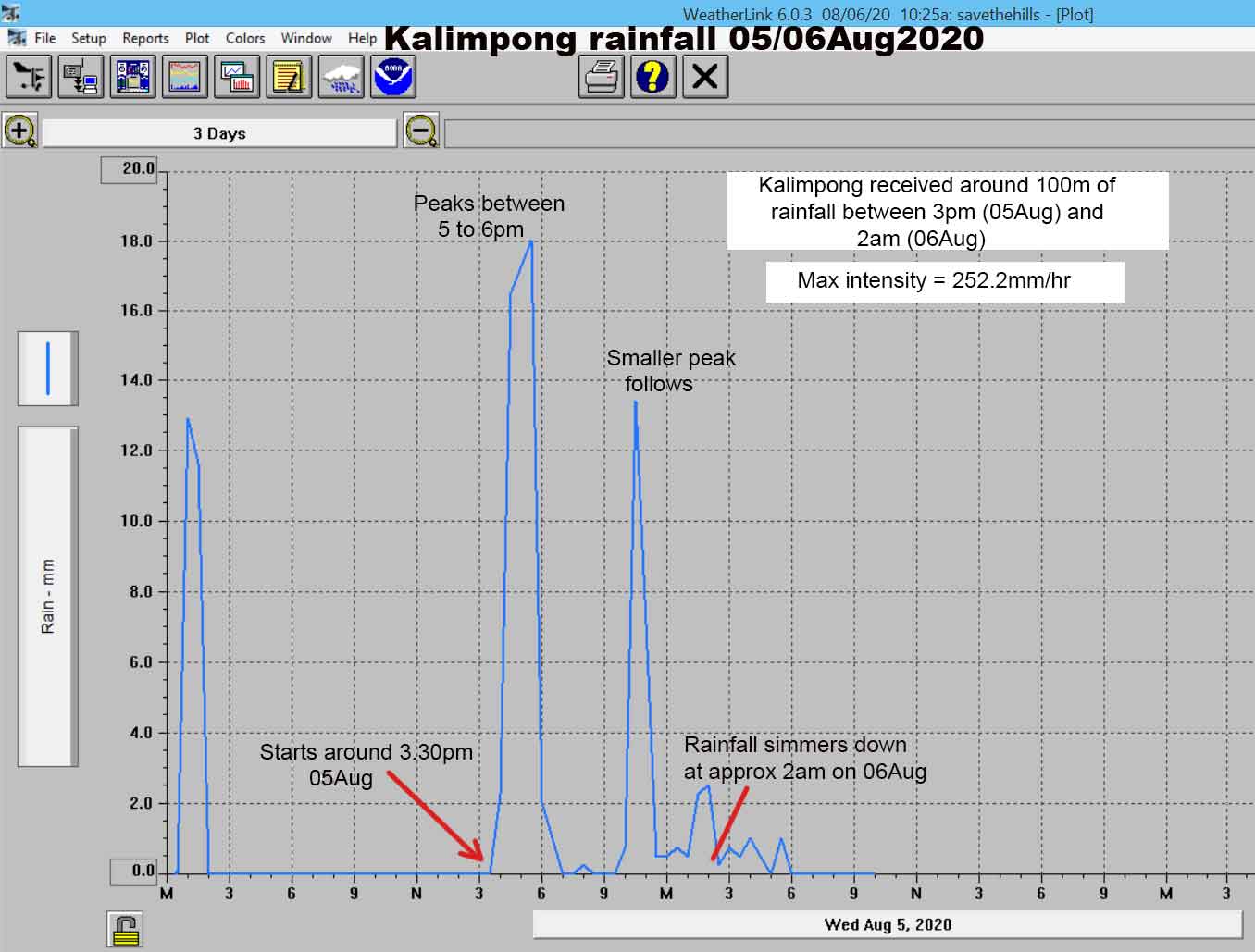
Graphs from AWS of SaveTheHills show the pattern of rainfall at Kalimpong on 05/06Aug2020 and 26/27Aug2020. In both cases, thundershowers commenced in the late evening or night and got over within a couple of hours with instantaneous rainfall intensities going upto 252mm/hr on 05Aug.

Did we have a cloud burst on 05Aug2020?
Even though we cannot prove it, I do believe we had one. Rainfall intensities reached never before levels of 252mm/hr and the event caused major damage to roads in Kalimpong and infrastructure in W Sikkim.

And it is not as if we have not had cloudbursts earlier
STH has already recorded the extreme rainfall events of AUGUST 2020 and their effects in earlier posts (see 1 and 2).

My thanks to Ms Shreya Gurung for compiling the rainfall data.

Praful Rao
Kalimpong district
Darjeeling-Sikkim HImalaya


Tuesday, January 21, 2020

Rainfall data of Darjeeling -Sikkim Himalaya Dec 2019 and compiled report for 2019

Many thanks to Ms Shreya Gurung for helping compile the above report

Annual rainfall for 2019 (compiled from STH reports in the past year)


Praful Rao
Kalimpong district
Darjeeling -Sikkim Himalaya

Thursday, August 22, 2019

Rainfall data of July2019 for the Darjeeling - Sikkim Himalaya

The torrential downpours between the 06July till 17Jul2019 caused a spate of damage all over the Darjeeling and Kalimpong districts and resulted in 5 deaths and many landslides. Links are placed below:
a. Either it's too little or too much
b. Extreme event in Darjeeling
c. Landslide report
A graphical representation of the rainfall over Kalimpong in July2019 (from our Davis AWS) is placed below:
A copy of the RED warning issued by IMD during the period is placed below and as far as I can remember, the first 2 weeks of July 2019 saw the largest consecutive number of RED warnings issued for heavy rain for SHWB (Sub-Himalayan W Bengal) and Sikkim:
The rainfall data (Jun-July2019) for Sikkim from IMD Sikkim is below:
Rainfall data of Gangtok, Damthang, Dentam and rainfall maps are from IMD.

Praful Rao
Kalimpong district,
Darjeeling - Sikkim Himalaya

Friday, August 16, 2019

5 year rainfall data of the Darjeeling - Sikkim Himalaya from CRIS (IMD)


Rainfall day-wise over the monsoon months, for the last 10yrs have been published on this blog for some main towns of the region.
The source for the above chart is here


Praful Rao
Kalimpong district
Darjeeling- Sikkim Himalaya

Friday, August 9, 2019

The terrifying new normal in rainfall: It's either too little or too much

As far as rainfall goes, June 2019 for us in the Darjeeling Himalayas ended with a net deficiency of -56%:
Exact figures in for the region from IMD are:
The average rainfall figures for the region being:

So while the rural community in Kalimpong district felt very anxious at the continued deficiency of rain (Apr and May2019 were also bone dry months), urban dwellers were also facing a severe water shortage and extraordinary heat in the pre-monsoon season.
Then came July and in 10 days (06-15Jul2019) we received 98% of our monthly rain in Kalimpong and Darjeeling with Kurseong, Siliguri going well over the monthly rainfall during the same period:
In Aug2019 thus far, in just 5 days Kalimpong has received 51.1% of the monthly rain for August.
This trend is being seen in the entire country be it Vadodra or Mumbai and the consequences of these events have been covered in this blog and also by the media
I wonder whether we realize what we are facing and are prepared to face the new normal in precipitation which is always either too little rain or too much.

Praful Rao,
Kalimpong district,
Darjeeling-Sikkim Himalaya

Monday, August 5, 2019

A mention from an Icon in his memoirs : Prof Leszek Starkel On SaveTheHills

In the world of Geo-morphology, Prof Leszek Starkel of the Polish Academy of Sciences stands tall.
A virtual giant of a man and a pioneer in the studies of landslides in the Darjeeling Himalaya, he first came to Darjeeling after the Oct 1968 disaster and continued to turn up almost every year thereafter to trudge these mountains and write volumes.
I came across him quite by accident. A friend had loaned me Prof Starkel's book on landslides some time in early 2008 and while flipping thru the pages I found his email address on the last page of the book. I shot off an email to him and promptly forgot about it, never expecting a reply from someone as famous or as busy.
Almost 6 months later I received a reply from him saying he would be in this area in the autumn of 2008 and would be happy to meet me. What followed was almost history for STH - we quickly organized the first Seminar on Landslide Hazards at Darjeeling with Prof Starkel as our keynote speaker.
I found his 'Memoirs' recently while researching the 1968 disaster and have published the excerpts below:
The images of the 21Nov2008 Seminar are here

Praful Rao,
Kalimpong district
Darjeeling-Sikkim Himalaya

Friday, July 26, 2019

Orange orchards of Darjeeling & Kalimpong - from the Best Growing Zones into Graveyards.

On 22Nov2015, I made a trip to Sittong in Kurseong subdivison (Darjeeling dist) to check out some landslides in that area. It was a day long trip and I visited some prominent landslides while enroute to the little hamlet and spent much of my day investigating the huge landslide in Sittong 3.
I also talked with some locals about the landslide situation there but while talking about their livelihoods they said oranges which were their main source of livelihood in Sittong were almost gone.
Of course, everyone here knows that oranges from Sittong once flooded the markets in Kalimpong and those along National Highway10 at Lohapul.
What the people I talked to feared most, was that along with oranges, their livelihoods for generations would also disappear.
They were correct.
Oranges as a cash crop in the Darjeeling-Kalimpong region is history today.
This news was brought out in the Telegraph on 25Nov2015 (see below) and I know that it was shown to a very high level official from the Govt of W Bengal who was visiting Kalimpong that day.

Therefore, I was surprised to read yesterday, another article by Vivek on 'Orange crisis in the hills' (below).

So 4 years later, while politicians still bicker and blame each other, the Darjeeling hills - once one of the 'best orange growing zones' in the country, is today a graveyard for orange orchards with the livelihoods of thousands destroyed and it is certainly NOT due to aging trees and orchards alone.
I visited some orchards in Bhalukhop bustee (village), Kalimpong some years ago and talked to a farmer who's crop was similarly blighted - he showed me the reason for the orange trees dying en masse (see below) despite being new plantations:


WIth many of our cash crops, ginger, oranges, now large cardamom succumbing to disease and pests, and the looming water crisis in the mountains where our natural springs are drying up, one wonders about food security in the Darjeeling -Sikkim Himalaya and future of agriculture as viable livelihood option for the rural youth of the region.

Praful Rao,
Kalimpong district,
Darjeeling -Sikkim Himalaya

Wednesday, June 12, 2019

IMPACT: a photo-essay on impact of landslides in the Darjeeling-Sikkim Himalaya


Impact


IMPACT is a photo-essay done by a layman (yrs truly) for laypersons on the impact of landslides on human beings in this region. I have compiled the photos from a 11yr period (except for those shared by Das Studio, Darjeeling) and have woven my observations/comments on them.
It is by no means complete and will be continued. What I am extremely apologetic about is the lack of hard core data since I did not have access to district or state records on the huge impact of landslides on loss of life, land, compensation paid or of rainfall while making this presentation.
Regrets for that.
I also have not included any technical details of the landslides shown in the images simply because I have no access to them.


Praful Rao,
Kalimpong district,
Darjeeling - Sikkim Himalaya

Tuesday, February 12, 2019

STH Activities in April 2018


In addition, the Darjeeling Himalaya Initiative which is the West Bengal state chapter of IMI were called for a meeting by the Principal Secretary (GTA) at Lal Kothi (Darjeeling) on  19April2018 to discuss the development and protection of Sandakhphu and the Singalila National Park.
SaveTheHills along with a number of Darjeeling based NGOs form the Darjeeling Himalaya Initiative.


Praful Rao,
Kalimpong district,
Darjeeling Sikkim Himalaya

Notice: STH blog resumes in Feb2019

It is with regret that I wish to announce that we were unable to continue the SaveTheHills (STH) blog after April 2018, having done so for almost 10years since STH was established in Sep2007.
The reason:-
  • In our experience, STH has found that other social media platforms are today more efficient and 'user friendly' to disburse warnings and information.
  • While blogging may have once been a wonderful tool, today STH operates a WhatsApp (WA) group called 'Hazard Alerts' (HA) which is a much more effective way of disbursing information and warnings.
  • WA along with other platforms like FaceBook reaches out to wider audiences and very quickly while the blog maybe restricted to the more serious reader and for preserving data and historical facts.
    However, since all of STH history and some useful data is published in the blog, STH will again start re-publishing the blog while apologizing for the break.

    Having completed updating rainfall records from April2018 toJan 2019 we will now record significant events which were undertaken by us and our partners in 2018 - much of which was about raising awareness on DRR and environmental issues of the region

    Praful Rao,
    Kalimpong district,
    Darjeeling - Sikkim Himalaya

Sunday, February 10, 2019

Monsoon 2018 synopsis

Monsoon 2018 report is here

Praful Rao,
Kalimpong district,
Darjeeling-Sikkim Himalaya