Showing posts with label landslide fatalities. Show all posts

Monday, June 26, 2023

First reported landslide fatalities in 2023 in the Himalayas -25Jun2023 (Mandi, Himachal Pradesh)

 Rainfall data from IMD Shimla

It seems ironic that even as 4 students from IIT (Mandi) are interns with STH in Kalimpong today and as such are learning about use of satellite imagery for early warning, rainfall and landslides, their campus in Mandi has been deluged with mud and overflowing run-off water.

Hope the knowledge and experience gained from this almost one month of internship will prove beneficial to the students.

Praful Rao (retd)
Kalimpong district
Darjeeling-Sikkim Himalaya

Thursday, August 22, 2019

Rainfall data of July2019 for the Darjeeling - Sikkim Himalaya

The torrential downpours between the 06July till 17Jul2019 caused a spate of damage all over the Darjeeling and Kalimpong districts and resulted in 5 deaths and many landslides. Links are placed below:
a. Either it's too little or too much
b. Extreme event in Darjeeling
c. Landslide report
A graphical representation of the rainfall over Kalimpong in July2019 (from our Davis AWS) is placed below:
A copy of the RED warning issued by IMD during the period is placed below and as far as I can remember, the first 2 weeks of July 2019 saw the largest consecutive number of RED warnings issued for heavy rain for SHWB (Sub-Himalayan W Bengal) and Sikkim:
The rainfall data (Jun-July2019) for Sikkim from IMD Sikkim is below:
Rainfall data of Gangtok, Damthang, Dentam and rainfall maps are from IMD.

Praful Rao
Kalimpong district,
Darjeeling - Sikkim Himalaya

Wednesday, January 13, 2016

Why STH must prevail - GSI's new map of landslide prone areas in the country


GSI, the nodal body for landslides in the country has recently updated their website with a more graphic map of the landslide prone areas of the country. An excerpt of the information on the GSI website is placed below :-
'In India, about 0.42 million sq. km or 12.6% of land area, excluding snow covered area, is prone to landslide hazard. Out of this, 0.18 million sq. km falls in North East Himalaya, including Darjeeling and Sikkim Himalaya; 0.14 million sq. km falls in North West Himalaya (Uttarakhand, Himachal Pradesh and Jammu & Kashmir); 0.09 million sq. km in Western Ghats and Konkan hills (Tamil Nadu, Kerala, Karnataka, Goa and Maharashtra) and 0.01 million sq. km in Eastern Ghats of Aruku area in Andhra Pradesh. The landslide-prone Himalayan terrain also belongs to the maximum earthquake-prone zones (Zone-IV and V; BIS 2002) where earthquakes of Modified Mercalli intensity VIII to IX can occur, and thus, are also prone to earthquake-triggered landslides. The most recent example is the aftermath of 18 September 2011 Sikkim Earthquake in the Sikkim-Darjeeling Himalayas.'

Italics and map insertion are mine.
Praful Rao,
Kalimpong,
Dist Darjeeling

Friday, June 7, 2013

About Dams .... and landslides.

Recently two interesting articles have appeared about dams and their impact on mountain environments.

Placed below is an excerpt quoting a CAG report on dams and its adverse effects on mountain ecology
 :-

Hydro projects causing degeneration of hill ecology: CAG
By Vishal Gulati | IANS India Private Limited – Wed 5 Jun, 2013
Shimla, June 5 (IANS)
'The hydropower projects in Himachal Pradesh -- in private and public sectors -- are not only gobbling up forests but also damaging natural resources, the Comptroller and Auditor General of India (CAG) has found.
The compensatory afforestation by the state is highly deficient as 58 percent of the test-checked hydropower projects reported no afforestation at all, the CAG said in its recent report.
It pointed out that lack of re-greening of hills poses severe hazards both to natural ecology and stabilisation of hill slopes……………….

Environmentalist R.S. Negi, who heads the Him Lok Jagriti Manch, a people's movement against upcoming hydro projects in Kinnaur district, told IANS: "The hydro projects are destructive not only to the rivers but also to traditional water channels."
"Before allocating any new project in the entire Himalayan region that falls in seismic zone-IV and the more severe zone-V, the government should first undertake carrying capacity and cumulative impact assessment of the projects," he said.'

The full article is here

Excerpt from another article on Large Dams and Landslides by Dr David Petley is below :-
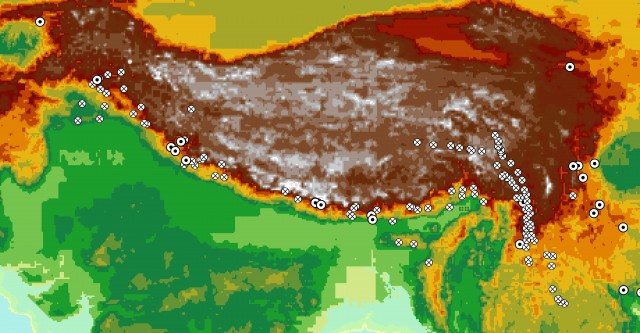
'The interesting thing here is the paucity of large dams in and around the Himalayan chain (and indeed the Andes).  As I have shown before, the Himalayas are really the global epicentre for landslide activity, so this is the environment that requires the highest level of care with respect to landslide problems. The map below homes in on the Himalayas, again with a DEM as the backdrop:

You will see that there are two types of symbol shown here. The circles with dots in the centre are locations in which my database indicates there have been fatality-inducing landslides associated with large dams in the last ten years. These are mostly landslides at dam construction sites or landslides that have impacted the camps housing employees associated with dam construction or operation. There are a surprising number of landslides given the numbers of dams in this part of the world. This suggests to me that we are not managing landslides properly in this part of the world. …….

My sense is that we are pushing our luck to the limit with the planned dams in and around the Himalayan Arc. The question as to whether these dams should be built at all is important but beyond the scope of this blog. However, the potential landslide problems in these areas are acute and will require a much higher level of management than appears to be occurring at present'


The full article is here

Italics in the above articles are mine.

Praful Rao,
Kalimpong