Showing posts with label Kathmandu. Show all posts

Tuesday, April 28, 2015

The Kathmandu Quake: A planning and preparedness study published 15 years ago and a view from an expert.

15 years ago a study titled ‘Kathmandu Earthquake Scenario’ was published by the National Society for Earthquake Technology (NSET- Nepal) and GeoHazards International (GHI) which dealt about a possible major earthquake disaster in  the region. The publication can be downloaded here.

Kathmandu Earthquake Scenario,
A product of the Kathmandu Valley Earthquake Risk
Management Project 
implemented by National Society for 
Earthquake Technology-Nepal (NSET-Nepal)
 and GeoHazards International (GHI)

What I am sure of is that the publication  was never read and lay collecting dust, like so many GSI reports on landslide hazards do in India. It is a pity what General William Westmoreland said way back in the 1960’s, of life being ‘cheap in the orient’ holds true to this day.

Prof. Dave Petley (Pro-VCO), University of East Anglia, UK, is one of the world's foremost experts on landslides and geo-hazards. His blog, has featured STH several times. 
His reply to our query regarding the numerous aftershocks in Nepal and the 27Apr2015 (5.1 R) quake near Mirik, Darjeeling district, is reproduced below:-

Dear Praful,

Many thanks for your email.  The earthquake in Nepal has been a terrible disaster. 

We have known for years that this area was overdue a large earthquake.  The mechanism and effects are not unexpected, and so far there is nothing terribly surprising.  In the aftermath of a large earthquake we would expect to see two types of earthquake events – aftershocks within the zone affected by the main shock, and induced earthquakes more widely.  We would expect these events to be substantially smaller than the main shock, but they can be quite large in their own right.

So what we are seeing is exactly what we’d expect to see.  There is no reason to panic – there is nothing to suggest a larger event is imminent, despite the rumours.  The aftershock sequence will settle down over time.  We would expect the largest aftershock for an M=7.8 earthquake to be M=6.8, so everything is as expected.

Hope that helps.  Best wishes,
Dave


Praful Rao
Kalimpong,
Dist Darjeeling

Update (28Apr2015) : List of Aftershocks and other Quakes in our region

Red dot shows induced earthquake at Mirik (Darjeeling dist, W Bengal)

Source of top data sheet : IMetD

Praful Rao,
Kalimpong,
Dist Darjeeling

Monday, April 27, 2015

Images from Ground Zero and a stark warning from another scientist : A letter from Prof Malay Mukul (IIT, Mumbai)


Prof Malay Mukul, of  the Dept of Earth Sciences, IIT Mumbai is from Kalimpong and has done extensive studies on the seismology of the Darjeeling-Sikkim Himalaya. 

He has contributed numerous articles to this blog, besides taking part in several seminars we had  organized. I had written to him after asking his inputs after the recent Nepal quake and I reproduce his reply in toto, in the hope that we living in this beautiful, yet fragile mountains may treat our home with more respect :-

First of all the earthquake was pretty much expected. (see here)

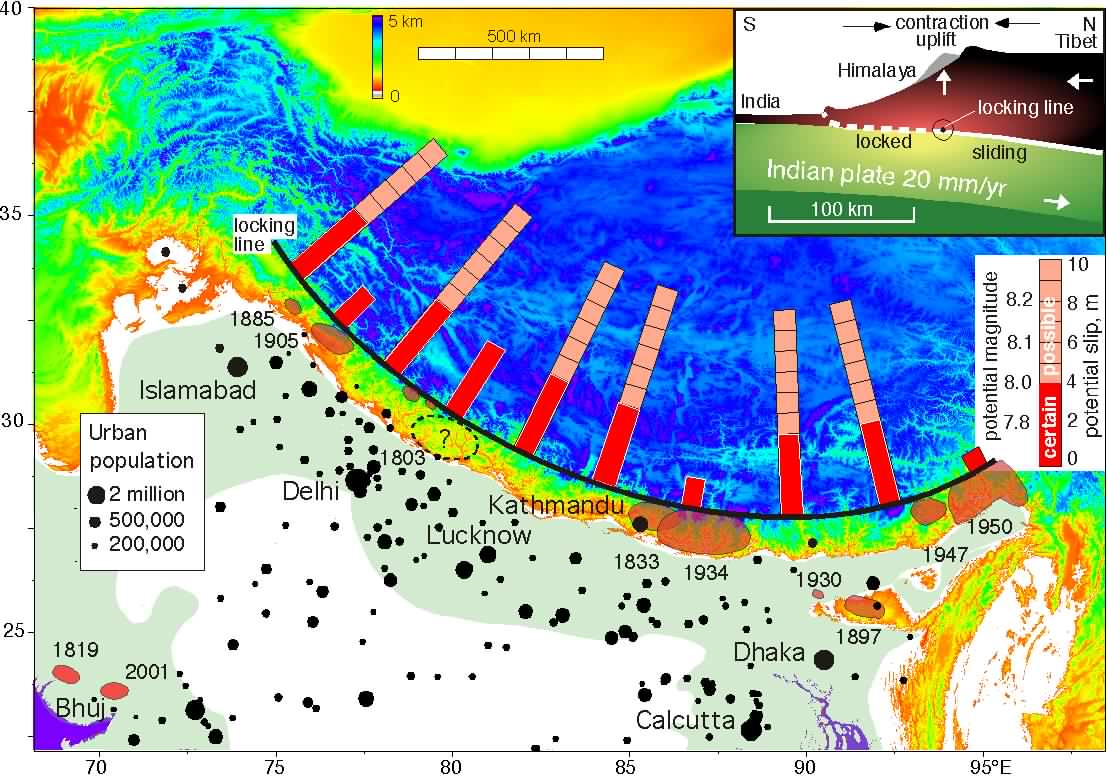
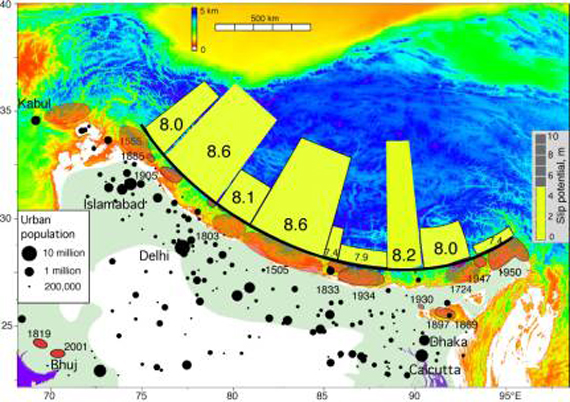
It was an earthquake that originated on the Main Himalayan Fault which is the basal thrust fault of the Himalaya and is also known as the Himalayan Decollement. Himalaya hosts many earthquakes; but the ones that involve the decollement are the great earthquakes whose magnitude is >8.0. These are the ones that all of us dread. The April 25, 7.9 Nepal Earthquake was a decollement earthquake and was bang in the middle of the high risk zone (Please see the two pictures given in the thread above, originally prepared by Roger Bilham, the longer the bar the higher is the seismic hazard in the region). The previous earthquake in the region was in 1934 and was a 8.1 earthquake which killed 10000 people. The expected projection for a repeat of that earthquake today was 49000. So who knows what will be the eventual death toll in this one.

What is also important and is evident from the two figures in the thread above is that there are other areas in the Himalayas that are waiting to be hit. Darjeeling-Sikkim is one of them. The 2011 earthquake was a strike slip one which is not the type we see in Nepal. We actually still await a Nepal kind of earthquake. With the concrete jungle that has mushroomed in our part of the Himalaya, Gangtok is likely to be our Kathmandu!

Aftershocks will continue for sometime. We have already had 45. There usually are a few aftershocks that are about 1 magnitude less that the main shock. We have already had a 6.7 and a 6.6 but most of the activity has been between 4-5. Aftershocks greater than 6.9 are not expected for this earthquake.

A final note: Although we can predict earthquakes in space, we are hopelessly off in earthquake prediction in time. So please do not believe any rumours that give you time predictions on earthquakes.

If you have questions, please let me know.

Best regards, Malay

Photo credits: CNN.


Praful Rao,
Kalimpong,
Dist Darjeeling

A warning gone unheeded : 'Nepal capital Kathmandu high risk area for catastrophic earthquake (2013)'

Placed below is an article published in Jan2013.
Kathmandu is one of the most vulnerable cities in the world, also experienced rapid urban development ..
The population has increased from 427,045 in 1991 to 671,805 in 2001 and is projected to touch a figure of 915,071 in 2011 and 975,453 in 2012 ..
Construction of buildings considered too weak to withstand a powerful quake, similar to Haiti catastrophic earthquake of M 7.0 what kill more of 316,000 people ..


Images of the Main Himalayan Thrust (MHT) fault showed that a segment of it dips downwards by 15 degrees, and is steeper and further north than suggested by previous observations. This dip could rupture and cause an earthquake of magnitude 8 or more, often referred to as a mega earthquake.
The researchers predict that the segment will break over a larger area of the fault and create a larger magnitude earthquake than previously thought.
"The larger the area of the fault that breaks, the more energy is released, and the larger the magnitude of the earthquake,"
The study, presented at the American Geophysical Union Fall Meeting in San Francisco earlier this month (7 December), measured ground movements. By placing seismometers closer together in one area, the researchers have been able to produce a more detailed image of the MHT. Klemperer says a big earthquake would start at the top of the sloping segment. "This is in central Nepal — where Kathmandu is — but such a big earthquake would devastate a much larger area." "This would cause huge landslides, some of which would dam rivers, and produce large lakes. There would be catastrophic floods," he says.
"The main area of concern is in central and west Nepal, where there has not been a large earthquake for a long period," Petley told AFP after Sunday's 6.9-magnitude quake damaged hundreds of homes in the east of the country. "This is an earthquake-prone area, so this suggests that there is a large amount of energy stored," he said.
Nepal is a highly seismic region, lying above the collision of the Indian and Eurasian plates that created the Himalayas, and major earthquakes have hit the Kathmandu Valley every 75 years on average over recent centuries.
One quake destroyed a quarter of homes in Kathmandu 77 years ago, and geologists believe the area is at immediate risk of an 8.0-magnitude tremor - ten times the size of last year's Haiti quake which killed more than 225,000 people.
"The building stock is not seismically strengthened, suggesting that in a big earthquake there will be large numbers of building collapses," said Petley, of the Institute of Hazard, Risk and Resilience at Britain's Durham University.
GeoHazards International, a US-based research group, has measured the likely death toll from a quake of 6.0 magnitude or higher hitting cities in Asia and the Americas.
Kathmandu topped the list of 21 cities with 69,000 potential deaths, ahead of Istanbul and New Delhi.
_________________________________________
Above article has been referred by
Prof Malay Mukul,
IIT, (Dept of Earth Sciences),
Mumbai

Praful Rao,
Kalimpong,
Dist Darjeeling

Saturday, April 25, 2015

Nepal 7.9R EarthQuake update : List of Aftershocks

Source
Death toll : India : approx 40. Nepal crossed 1000 at 1930h IST.
Comunication is becoming difficult with our relatives and friends in Kathmandu because of power outages and their inability to charge mobile devices.

Praful Rao,
Kalimpong,
Dist Darjeeling

Quake Report : 7.9R earthquake near Kathmandu (Nepal) at 12:15:20hrs IST on 25Apr2015


28.131°N 84.649°E. Depth=15.0 km (9.3 mi) 

Nearby Cities

  1. 49km (30mi) E of Lamjung, Nepal
  2. 69km (43mi) NW of Kirtipur, Nepal
  3. 70km (43mi) NW of Kathmandu, Nepal
  4. 70km (43mi) NE of Bharatpur, Nepal
  5. 72km (45mi) NW of Patan, Nepal

       Tectonic Summary
Seismotectonics of the Himalaya and Vicinity

    1. Seismicity in the Himalaya dominantly results from the continental collision of the India and Eurasia plates, which are converging at a relative rate of 40-50 mm/yr. Northward underthrusting of India beneath Eurasia generates numerous earthquakes and consequently makes this area one of the most seismically hazardous regions on Earth. The surface expression of the plate boundary is marked by the foothills of the north-south trending Sulaiman Range in the west, the Indo-Burmese Arc in the east and the east-west trending Himalaya Front in the north of India.(Read more here)

      You can get technical updates of the earthquake here and here

      As per news reports, death toll in Nepal at the time of writing is 150 with another 18 deaths being reported in India. 14 after shocks have been reported. The fatalities will certainly increase with time and also the bad news is that this quake comes just as the SW monsoons are around the corner and we have 5 months of rains ahead where water ingress into the cracks and fissures in the mountains formed as a result of the 7.9R quake will lead to landslides.

      Sources : USGS/CNN

      Praful Rao,
      Kalimpong,
      Dist Darjeeling
      1530h (IST)


Friday, June 14, 2013

A tale of two Summits (SMDS III and MGDA-11).

For further information on the above see links here (for Sustainable Development Summit III) and here for MGDA-11.

Praful Rao,
Kalimpong