Showing posts with label aftershocks. Show all posts

Sunday, May 17, 2015

Nepal Earthquake: Some questions and answers from an expert regarding the 16May2015 aftershocks felt in the Darjeeling-Sikkim Himalaya

On  16May2015, we in the Darjeeling-Sikkim Himalaya felt two aftershocks and after checking their positions in the USGS map, I could not help feeling the 'epicentre' of the aftershocks had shifted eastwards towards us. I posed this question to Dr Malay Mukul of IIT Mumbai; placed below are my questions/statements (in Italics) and Dr Mukul's answers :-

1. Can't even imagine how it must be in Nepal; we in the Darjeeling-Sikkim region felt 2 aftershocks on 16May2015 (centred East of Banepa at 0920h IST and North of Ramechhap at 1704h IST).

Nepal obviously is feeling the brunt of it. Again, for a 7.3 triggered shock one would expect aftershocks typically up to 6.3. For the two events we have had the following:-


Fig 1(above): The epicentral plot of the main events and the major aftershocks associated with the Nepal 2015 Earthquake.
For 7.8 event we had 6.1, 6.6, and 6.7 aftershocks. For the 7.3 we have had 6.3 and 5.7. So far no real anomalies except that 7.8 shock triggered a 7.3 event farther east. The aftershocks associated with the 7.3 event were located near the epicenter of the 7.3 event so nothing abnormal about that. The orange event (Fig 1) was yesterday's aftershock. Pretty much within the cluster. Not suggesting that the rupture is going farther east. At least not yet!

2. What I find disturbing is the fact that the aftershock 'epicentres' SEEM to be moving from west of Kathmandu initially, eastwards towards our area.Which I think you also pointed out in yr last letter (published here). Can this be correct?

Yes! The aftershocks did tend to follow the Main Himalayan fault (MHT) from west to east. However, the map below (Fig 2) shows that apart from the Mirik event (27Apr2015), the earthquakes have been clustered within the area more or less defined by the two 7+ events. So I would say, no evidence of the aftershocks propagating farther east as of now. If aftershocks transcend the East and Central Nepal boundary, we really need to start worrying.


Fig 2: Epicentral plots of the main events and the aftershocks associated with the Nepal earthquake 2015.

3. Without being an alarmist, I do hope our administration and political leaders are aware of the possibilities and consequences should an event take place here- having served in the IAF and worked in disaster management, I believe it is better to overreact in crisis situations rather than not react at all.

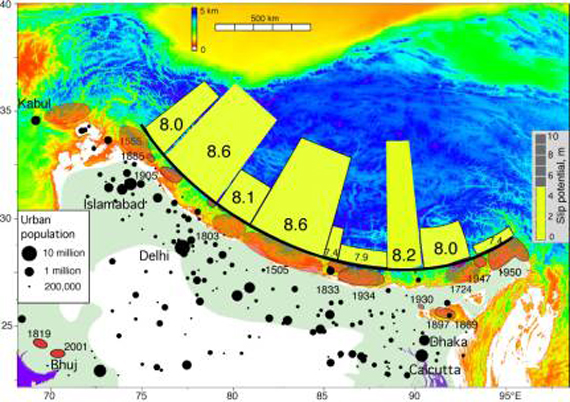
I agree that we need to have a realistic disaster management plan in place in our region both in the short and the long term. That is the least we can do in the light of the fact that we have been made acutely aware of our vulnerability to big Himalayan earthquakes by the Nepal 2015 event and future projections of a 8.2 to 8.7 earthquake in our part of the Himalaya (Fig 3).


Fig 3: Darjiling-Sikkim is projected to be vulnerable to a 8.2 decollement earthquake in the future.
 ___________________________

Praful Rao,
Kalimpong,
Dist Darjeeling

Wednesday, May 13, 2015

The 12May2015 Nepal Quake : An expert's view


Dr Malay Mukul of IIT Mumbai (Dept of Earth Sciences) hails from Kalimpong and has contributed numerous articles to this blog. After yesterday's quakes which rattled much of India, I posed him this question :
'What the hell is happening in our region?'
His reply is placed below :-
_________________________________________
The 12May2015, 7.3 earthquake in eastern Nepal was not completely unexpected. When we had the December 2004, 9.1 Indian Ocean Earthquake, there was similar 8.6 shock in March 2005. There were also two 8+ events in 2007. So once the beast wakes up, it will take its own time to settle down. We can do precious little to change this except either to get out of the way and live in safer places in peninsular India or, if that is not an option, to live in houses that will not kill us during a great earthquake (magnitude 8 and above).
Today's 7.3 earthquake appears to be identical to the 7.8 event. Same fault plane at almost identical depths. The fault that got active is the basal decollement fault of the Himalaya called the Main Himalayan Thrust. This is a fault that is present at the base of the Himalaya and extends from Kashmir to Arunachal Pradesh. Obviously, it is present below us in the Darjeeling-Sikkim Himalaya too.
All the GPS work people have been doing in the Himalaya tells us how much this fault is slipping per year in different parts of the Himalaya. It was about 18 mm/year in the Nepal Himalaya and looks like it is about 16 mm/yr in Darjeeling-Sikkim.
Imagine a beaker filling up with water at this rate. So the question is when will the beaker completely fill up? Once it does, nature empties it out in an event like the Nepal 7.9 earthquake.After that it starts filling up again.
Two scenarios can arise because of this:
1.The 7.9 event also causes a southward lurch of the Himalaya. In the 7.9 event, the Himalaya lurched south by about 4m at 15km depth which was effectively about 1m at the surface. This lurch would also add strain (or water in our example to the beaker that is filling up nearby)to the whole
system. If this sudden addition causes the beaker to fill up in an adjacent region,another event would occur. Strictly speaking it is not an aftershock and a separate event by itself with its own aftershocks.
However, it is an event that is triggered by the main event.
2. The beaker did not empty completely during the 7.9 event. In that case the beaker simply empties itself in two events rather that one. This is definitely better than having a single bigger event. Two 7+ earthquakes are better than one 9 event!
The aftershocks of the 7.9 event showed that the earthquake rupture was propagating east. In fact today's event was very close to the region where we saw a 6.7 aftershock earlier. Would it trigger an event in Darjeeling-Sikkim? It could, if we think the first scenario was operational.
Yes! I totally agree with you, having an earthquake on the decollement or the Main Himalayan Thrust in the Darjeeling-Sikkim Himalaya would be our worst nightmare. We have been very lucky. Nature has given us three warnings!  September 2011 and the 2015 Nepal events.
All projections seem to point to us and say that we could be next. We need to get our act straight! The NIMBY (not in my backyard) syndrome may no longer be applicable to us!
________________________________________________________
Comment by Praful Rao

The writing on the wall is writ large and clear.
Increasingly and every year, disasters in and around the Himalayas (hydrological and geo) are taking a huge toll both in terms of human lives and economic losses. Yet, despite 'the three warnings' Prof Mukul talks about or the recent Kashmir and Uttarakhand disasters I am sure nothing much will change and we will continue our 'normal activities' as if nothing ever happened.

Praful Rao,
Kalimpong,
Dist Darjeeling


Sunday, May 10, 2015

Nepal 7.9R Earthquake (25Apr2015) : 96 Aftershocks (in two weeks) and still counting...

Placed above is a record of aftershocks (source) following the 7.9R earthquake which devastated large parts of Nepal on 25Apr2015. There have been 96 aftershocks till date (including the induced 5.1R quake which was epicentred around Mirik.
In order to generate awareness about quakes especially amongst the people of the Himalayas, I posed several questions to experts.
The questions and answers (in this case given by Dr Malay Mukul, of IIT Mumbai, Dept of Earth Sciences) are placed below :-
Q. Regarding the Nepal quake, why are there so many aftershocks WITHIN a short time frame - 96 within a time span of 2 weeks? The 6.8R (18Sep2011) Sikkim earthquake which we experienced never generated so many aftershocks.
A. This is normal. If you just see the aftershock records for the Bhuj earthquake,you will find that they continued for months after the main shock. You would see is a gradual decrease in the aftershock magnitude as well as number of events. Now we are mostly getting 3s and 4s.
The aftershock activity is also a function of the magnitude and depth of the main earthquake. Shallower and large magnitude main shocks create more intense aftershock activity.
The Sikkim earthquake was much lower in magnitude as well as deeper.
Q. Are the continuous rattling (aftershocks) dangerous for installations and structures already weakened by previous tremors? I know that 2 hydel projects in Darjeeling district suffered some damage during the recent quake.
A. Yes! Aftershocks tend to add to the damage created by the main shock and in many cases topple structures that were still standing at the end of the main shock. So if your building has suffered structural damage you need to make sure you either fix it or stay away from it.

______________________________________________________________

Comment by Praful Rao
My thanks to Dr Malay Mukul for his prompt answers. 

Two major earthquakes have shaken in this region within the last 4 years, (6.8RSikkim and the recent Nepal one), yet we continue to flout all regulations regarding building codes and continue to construct thousands of 8-9storey buildings on these fragile mountains. I also wonder whether the numerous dams that we have constructed or are constructing  are safe?


Praful Rao,
Kalimpong,

Dist Darjeeling

Wednesday, April 29, 2015

Hope amidst Hopelessness and an Expert's view


In a bid to throw light on the probable cause, duration and impact of the 25th April 2015 Nepal earthquake, STH has been contacting several renowned experts in seismology and disaster management. Thus the grim foreboding for the Darjeeling-Sikkim region from Prof. Malay Mukul of IIT, Mumbai (Dept. of earth sciences) is placed here.

A clarification/assessment of the frequent aftershocks following the 7.9 R earthquake by Prof. Dave Petley (Pro-VCO), University of East Anglia, UK, is placed here.

Prof. Rajendra Bhandari is acknowledged as one of the leading experts in the world on landslides. An excerpt of his letter to STH regarding the Nepal earthquake is published below:-

"The Nepal earthquake should not have surprised us because a number of studies expected a repeat of 1934 Bihar-Nepal earthquake. Similarly, India should not be surprised if the 1897 Shillong earthquake repeats anytime. Unfortunate we begin to speak of earthquakes and landslides only after the events and do nothing between the events. Then we fool ourselves by throwing up the argument that earthquakes are to be accepted because we cannot predict them. Why can we not fix all the major landslides in Shillong, Darjeeling and other parts of NE by spending 1000 crores before the Shillong earthquake arrives? 

Perhaps this 1000 crore is reserved for the families of those who would die in the quake. Why do we not retrofit all our hospitals so that victims will not have to wait for the Pakistani plane to arrive! Why do we not train communities, make earthquake-proof shelters and improve communication systems. We need a strong will to do something before our own day of departure comes. 

The aftershocks post Gujarat earthquake were also as alarming. My gut feeling is that the major event for the time being is over even though some aftershocks may keep repeating. The magnitude of aftershocks would also diminish within a few days. Had this earthquake been of magnitude 5.5-6 to begin with, perhaps those would have been fore shocks, appearing as the advance team of the main event to follow."

Praful Rao
Kalimpong,
Dist Darjeeling

Photo credits: CNN


Tuesday, April 28, 2015

The Kathmandu Quake: A planning and preparedness study published 15 years ago and a view from an expert.

15 years ago a study titled ‘Kathmandu Earthquake Scenario’ was published by the National Society for Earthquake Technology (NSET- Nepal) and GeoHazards International (GHI) which dealt about a possible major earthquake disaster in  the region. The publication can be downloaded here.

Kathmandu Earthquake Scenario,
A product of the Kathmandu Valley Earthquake Risk
Management Project 
implemented by National Society for 
Earthquake Technology-Nepal (NSET-Nepal)
 and GeoHazards International (GHI)

What I am sure of is that the publication  was never read and lay collecting dust, like so many GSI reports on landslide hazards do in India. It is a pity what General William Westmoreland said way back in the 1960’s, of life being ‘cheap in the orient’ holds true to this day.

Prof. Dave Petley (Pro-VCO), University of East Anglia, UK, is one of the world's foremost experts on landslides and geo-hazards. His blog, has featured STH several times. 
His reply to our query regarding the numerous aftershocks in Nepal and the 27Apr2015 (5.1 R) quake near Mirik, Darjeeling district, is reproduced below:-

Dear Praful,

Many thanks for your email.  The earthquake in Nepal has been a terrible disaster. 

We have known for years that this area was overdue a large earthquake.  The mechanism and effects are not unexpected, and so far there is nothing terribly surprising.  In the aftermath of a large earthquake we would expect to see two types of earthquake events – aftershocks within the zone affected by the main shock, and induced earthquakes more widely.  We would expect these events to be substantially smaller than the main shock, but they can be quite large in their own right.

So what we are seeing is exactly what we’d expect to see.  There is no reason to panic – there is nothing to suggest a larger event is imminent, despite the rumours.  The aftershock sequence will settle down over time.  We would expect the largest aftershock for an M=7.8 earthquake to be M=6.8, so everything is as expected.

Hope that helps.  Best wishes,
Dave


Praful Rao
Kalimpong,
Dist Darjeeling

Update (28Apr2015) : List of Aftershocks and other Quakes in our region

Red dot shows induced earthquake at Mirik (Darjeeling dist, W Bengal)

Source of top data sheet : IMetD

Praful Rao,
Kalimpong,
Dist Darjeeling

Monday, April 27, 2015

Images from Ground Zero and a stark warning from another scientist : A letter from Prof Malay Mukul (IIT, Mumbai)


Prof Malay Mukul, of  the Dept of Earth Sciences, IIT Mumbai is from Kalimpong and has done extensive studies on the seismology of the Darjeeling-Sikkim Himalaya. 

He has contributed numerous articles to this blog, besides taking part in several seminars we had  organized. I had written to him after asking his inputs after the recent Nepal quake and I reproduce his reply in toto, in the hope that we living in this beautiful, yet fragile mountains may treat our home with more respect :-

First of all the earthquake was pretty much expected. (see here)

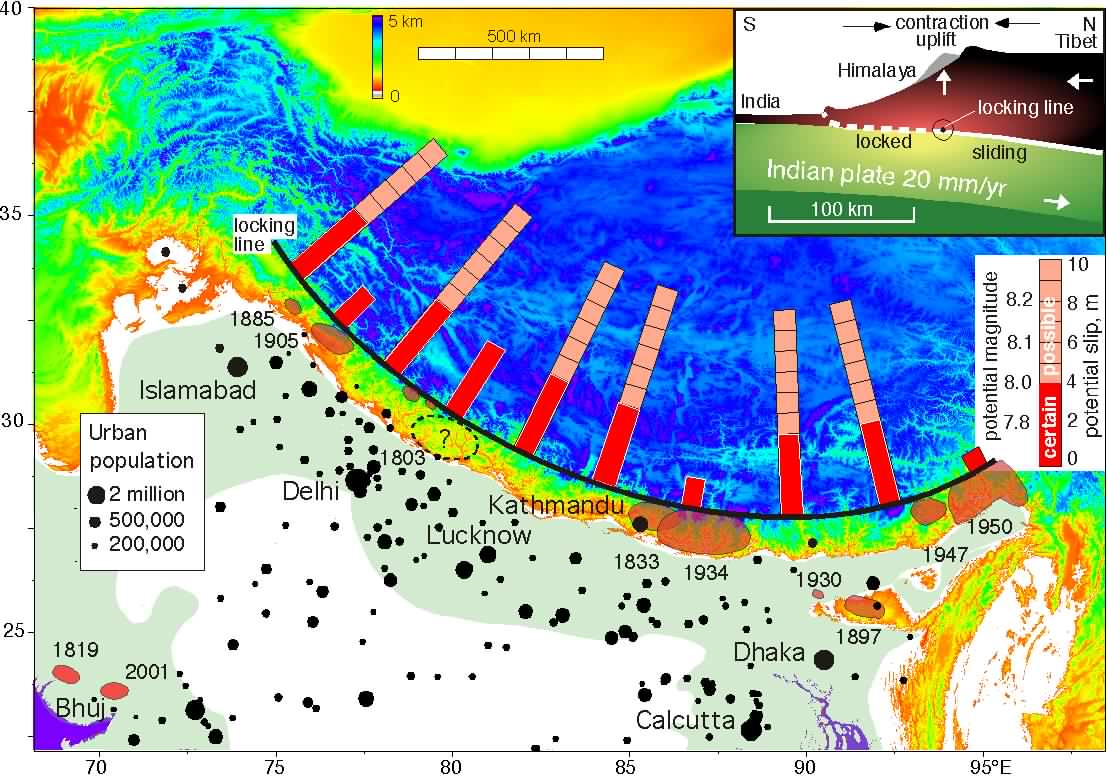
It was an earthquake that originated on the Main Himalayan Fault which is the basal thrust fault of the Himalaya and is also known as the Himalayan Decollement. Himalaya hosts many earthquakes; but the ones that involve the decollement are the great earthquakes whose magnitude is >8.0. These are the ones that all of us dread. The April 25, 7.9 Nepal Earthquake was a decollement earthquake and was bang in the middle of the high risk zone (Please see the two pictures given in the thread above, originally prepared by Roger Bilham, the longer the bar the higher is the seismic hazard in the region). The previous earthquake in the region was in 1934 and was a 8.1 earthquake which killed 10000 people. The expected projection for a repeat of that earthquake today was 49000. So who knows what will be the eventual death toll in this one.

What is also important and is evident from the two figures in the thread above is that there are other areas in the Himalayas that are waiting to be hit. Darjeeling-Sikkim is one of them. The 2011 earthquake was a strike slip one which is not the type we see in Nepal. We actually still await a Nepal kind of earthquake. With the concrete jungle that has mushroomed in our part of the Himalaya, Gangtok is likely to be our Kathmandu!

Aftershocks will continue for sometime. We have already had 45. There usually are a few aftershocks that are about 1 magnitude less that the main shock. We have already had a 6.7 and a 6.6 but most of the activity has been between 4-5. Aftershocks greater than 6.9 are not expected for this earthquake.

A final note: Although we can predict earthquakes in space, we are hopelessly off in earthquake prediction in time. So please do not believe any rumours that give you time predictions on earthquakes.

If you have questions, please let me know.

Best regards, Malay

Photo credits: CNN.


Praful Rao,
Kalimpong,
Dist Darjeeling

A warning gone unheeded : 'Nepal capital Kathmandu high risk area for catastrophic earthquake (2013)'

Placed below is an article published in Jan2013.
Kathmandu is one of the most vulnerable cities in the world, also experienced rapid urban development ..
The population has increased from 427,045 in 1991 to 671,805 in 2001 and is projected to touch a figure of 915,071 in 2011 and 975,453 in 2012 ..
Construction of buildings considered too weak to withstand a powerful quake, similar to Haiti catastrophic earthquake of M 7.0 what kill more of 316,000 people ..


Images of the Main Himalayan Thrust (MHT) fault showed that a segment of it dips downwards by 15 degrees, and is steeper and further north than suggested by previous observations. This dip could rupture and cause an earthquake of magnitude 8 or more, often referred to as a mega earthquake.
The researchers predict that the segment will break over a larger area of the fault and create a larger magnitude earthquake than previously thought.
"The larger the area of the fault that breaks, the more energy is released, and the larger the magnitude of the earthquake,"
The study, presented at the American Geophysical Union Fall Meeting in San Francisco earlier this month (7 December), measured ground movements. By placing seismometers closer together in one area, the researchers have been able to produce a more detailed image of the MHT. Klemperer says a big earthquake would start at the top of the sloping segment. "This is in central Nepal — where Kathmandu is — but such a big earthquake would devastate a much larger area." "This would cause huge landslides, some of which would dam rivers, and produce large lakes. There would be catastrophic floods," he says.
"The main area of concern is in central and west Nepal, where there has not been a large earthquake for a long period," Petley told AFP after Sunday's 6.9-magnitude quake damaged hundreds of homes in the east of the country. "This is an earthquake-prone area, so this suggests that there is a large amount of energy stored," he said.
Nepal is a highly seismic region, lying above the collision of the Indian and Eurasian plates that created the Himalayas, and major earthquakes have hit the Kathmandu Valley every 75 years on average over recent centuries.
One quake destroyed a quarter of homes in Kathmandu 77 years ago, and geologists believe the area is at immediate risk of an 8.0-magnitude tremor - ten times the size of last year's Haiti quake which killed more than 225,000 people.
"The building stock is not seismically strengthened, suggesting that in a big earthquake there will be large numbers of building collapses," said Petley, of the Institute of Hazard, Risk and Resilience at Britain's Durham University.
GeoHazards International, a US-based research group, has measured the likely death toll from a quake of 6.0 magnitude or higher hitting cities in Asia and the Americas.
Kathmandu topped the list of 21 cities with 69,000 potential deaths, ahead of Istanbul and New Delhi.
_________________________________________
Above article has been referred by
Prof Malay Mukul,
IIT, (Dept of Earth Sciences),
Mumbai

Praful Rao,
Kalimpong,
Dist Darjeeling

Saturday, April 25, 2015

Nepal 7.9R EarthQuake update : List of Aftershocks

Source
Death toll : India : approx 40. Nepal crossed 1000 at 1930h IST.
Comunication is becoming difficult with our relatives and friends in Kathmandu because of power outages and their inability to charge mobile devices.

Praful Rao,
Kalimpong,
Dist Darjeeling