Showing posts with label 14th Mile. Show all posts

Friday, March 28, 2025

How nature heals: a look at several landslides in Kalimpong

Massive landslide at Bhalukhop (Kalimpong district) on 29Jul2021, following 232mm rainfall in 13hrs. Nature has slowly healed this area over a 4 year period without any engineering mitigation measures being applied.

By no stretch of imagination am I an expert on landslides but having visited numerous landslides over the years and having observed the changes taking place, I believe that under the right circumstances and with time, nature has a remarkable way of healing landslides.
Here are case studies and photos of 3 landslides in and around Kalimpong:

14th mile landslide in Kalimpong

This is a really old landslide and 'a sinking zone' which existed more than 50 years ago. STH has covered this extensively in this blog in 2007 and in 2010

Drone image of 14th Mile landslide on 21Feb2025. The whole landslide area is now covered with trees


Massive Landslide at Bhalukhop (Kalimpong district) on 30Jul2021.

A 232mm rainfall over a 13hr period on 29/30July2021 triggered a massive  landslide in my village, Bhalukhop in Kalimpong; the incident has been covered in a STH blogpost here. I have placed a Google Earth image of the landslide path below:

The length of the slide from crown to toe was approx 1880 ft (measured on Google Earth).
Where the landslide started - at the crest near Deolo Hill.
The mid-section of the slide in Dec2021
Ms Minu Thapa,showing us the extent of devastation in her farm at the base of the landslide in Dec2021
In this Feb 2025 drone image; Ms Minu Thapa's home lies just above the road bend and the entire landslide affected area all the way to the crest is seen covered with vegetation and trees, 4 years after the terrible Jul2021 landslide.
Another drone image of the landslide affected area - showing no trace of the landslide after nature took over.
 

Dhajey, Bara Bhalukhop

As a native of this village, I'm deeply familiar with the landslide issues in our area. To address this problem, the local community employed a traditional mitigation method at Dhajey, which involved a three-step approach:

1. Water diversion: A concrete river training structure was built to channel water away from the landslide-prone area (see top photo).
2. Soil stabilization: Bamboo palisades were constructed to prevent soil erosion during rainfall, allowing pioneer species like mosses and lichens to take root. Under favorable conditions, grasses and small shrubs would emerge within a year, anchoring the soil and reducing erosion. Alternatively, jute matting or fiber could have been used to support the new vegetation (lower photo).
3. Long-term stabilization: Over several years, larger plants like bushes and shrubs would grow, holding the soil together and enabling deeper-rooted species like trees to develop, further binding the soil through nature's "soil nailing" process.

Drone image of this area on 21Feb2025 is shown below👇. The RED circle delineates the area where the bamboo check dams were 'planted'.
Drone image of landslide areas at Dhajey, Bara Bhalukhop👇
1 - A large landslide had taken place here several years ago, which  nature has apparently healed.
  2 - Area where locals applied tradtitional bamboo check dam mitigation measures which has stabilized the place at least for the past 2 monsoons.
 
Documentation of parts of the above report was supported by Royal Enfield, as part of their Social Mission Initiative


Praful Rao
SaveTheHills
savethehills@gmail.com
9475033744


Sunday, September 13, 2020

Landslide Report 3 (Kalimpong) - Sep2020

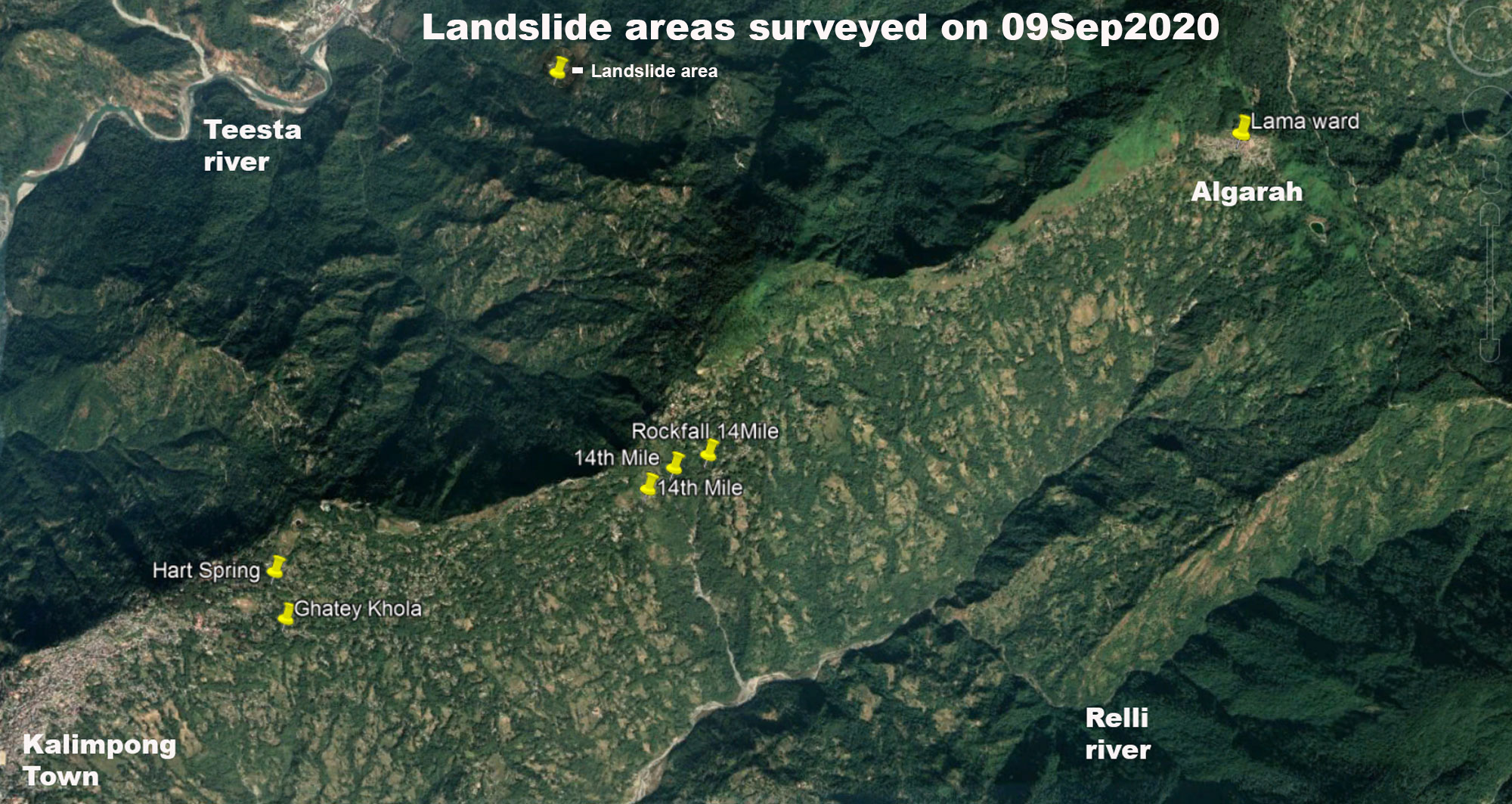
Continuing with the landslide surveys (See Report 1 and Report 2 in this blog)  around Kalimpong town, on 09Sep2020, we went to the north eastern sector of Kalimpong along Reshi Road upto ALGARAH. This road is of strategic importance to India since much of the logistics for the Indian army in East Sikkim (opposite Doklam) goes thru this road. Also in case of NH10 being blocked, this road, via Lava/Gorubathan serves as the alternate route to Siliguri.
Regarding the survey:
  • Besides the landslide/subsidence zones mentioned below, what was very evident was the serious deterioration in the condition of the Kalimpong -Algarah section of Reshi road with numerous sinking areas visible on many parts of the road, where another heavy shower or two could result in collapse of the road at multiple places.
  • What should be also noted here is that the entire region has many natural springs and jhoras which during heavy rain causes a lot of erosion and landslides in the area.
  • STH has recorded the extreme rainfall events of AUGUST 2020 and their effects in earlier posts (see 1 and 2). Further the rainfall of August 2020 is also available in this blog. All the landslides recorded below were the result rainfall during the extreme rainfall events.
GHATEY KHOLA subsidence

Coordinates: 27° 4'42.00"N, 88°29'50.88"E
Size of subsidence of road : approx 45m in length
During periods of intense rain, Ghatey Khola is notorious for causing landslides in this area since the runoff from the entire populated areas at the crest of the hill finds its way into this drain.
14th Mile sinking zones
The 14th mile sinking areas have been featured in this blog numerous times (see 1 and 2) and are one of the oldest landslide zones in Kalimpong. During the heavy rains of August 2020, these areas were re-activated at almost the same locations causing large portions of the Kalimpong- Algarah road (Reshi Road) to subside.
No other damage to farmland or infrastructure was observed.


Sinking areas of Algarah town
Algarah town is approx 15 kms NE of Kalimpong and has a long history of landslides. I had visited the area some years ago and marked out the sinking areas (above). WIth less rainfall in the past few years, the landslide and sinking zones had also diminished. This year with the intense rains that we have had, the hotspots have re-emerged and perhaps the most crucial one is the one in LAMA WARD which is located in the centre of Algarah town.

Coordinates: 27.1172° N, 88.5837° E
Landslide at HART spring, Dr Graham's Homes, Kalimpong

Coordinates: 27° 4'56.22"N, 88°29'48.48"E 

Photo credits: Ms Shreya Gurung

Praful Rao,
Kalimpong district
Darjeeling- Sikkim Himalaya

Monday, December 16, 2013

From the Telegraph today : Good news for the Heritage Darjeeling Himalayan Railway (DHR)


Tindharia tracks to open soon
Siliguri, Dec. 15: The toy train tracks at Tindharia have been relaid soon and service from Siliguri to Gayabari is set to resume later this month.
“We plan to resume the service to Gayabari with a big bang. A special train will be operated from Siliguri Junction till Gayabari (34km) on that day. The date will probably be December 26. The work of relaying tracks at Tindharia has more or less been completed. We plan to conduct a trial run on the newly laid tracks this week,” Arun Kumar Sharma, the divisional railway manager of Katihar division of Northeast Frontier Railway, said over the phone from Katihar today.
A landslide at Paglajhora on NH55 in June 2010 disrupted the services from Siliguri to Kurseong.

STH has covered this issue extensively earlier - see here

Praful Rao,
Kalimpong,
Dist Darjeeling

Monday, May 3, 2010

The 14th Mile Landslides in Kalimpong revisited -02May2010

I have covered the 14th Mile landslide problem (here) at Kalimpong earlier in 2007 .
On 02May2010, I was invited by village people of the area to have a detailed look at the area again. What we did was walked all the way form the top (GPS Waypoint 41) to the base of the natural rivulet (GPS Waypoint 47) which is the cause of the instability in the area. During the course of the 5hr walk we interacted with affected people of the area and saw what has now become a familiar sight - farmland which has disappeared, homes which are cracked and despair written on the faces of people.
Even though this problem has been persisting for many decades now, nothing has been done to mitigate or otherwise control this hazard as such now it seems virtually uncontrollable.