Friday, November 24, 2023

Photographic record of the impact of 04Oct2023 GLOF between Sangkalang and Toong ( North Sikkim) -18Nov2023.

The main road (NH310A) from Mangan to Chungthang (29kms) is blocked near Naga and the bridge at Toong has been swept away, as such now the only road to Chungthang is as shown in RED below which is 40kms long and takes double the time (ie 2hrs).
We made this trip in the early hours of 18Nov2023, leaving Dzongu at 4.30am so that we could spend the whole day covering Chungthang and its vicinity (that will be covered in the subsequent blog).
This blog only records the GLOF disaster at Naga, Ritchu and Toong villages in the Teesta valley, in Mangan, North Sikkim and on NH310A.

The alternate route to Chungthang
Prior to starting a steep climb, one encounters this bridge (27 31 33.5 N 88 31 40.6) Elev 483m/1564', over the pristine and beautiful Kanaka river. See Praveen's drone image below.
Thereafter, the road snakes up in a series of 45 bends at the bottom of the hill and climbs to an altitude of almost 7000'. At places the road is very narrow, hewn out of bare rock with the road edge perilously close..an accident here would mean a fall into a gorge several thousand feet deep and sure death.
This is definitely not a road suitable for heavy vehicles and traffic, being steep, narrow at places and even dangerous.
The army does not allow their vehicles to ply on this route.
After driving on this route for an hour plus we came across areas in the Teesta valley and opposite hill which showed the scars of the GLOF and dam burst on 04Oct2023.

Destruction in Ritchu and Naga village
(27.548536N 88.643017E)
, Mangan district.

Drone images by Praveen of affected areas around Naga village (Mangan district), North Sikkim are given below:
Telephoto images of the same area are below
These photos were taken from (27 32 58.9 N 88 37 48.3 E). There was a lot of haze in the atmosphere hence the discoloration in the photos.
As per Phurkit Lepcha of Shipgyer (village enroute to Chungthang), whom we interviewed - these landslides in the village of Ritchu or Bong (in Toong-Naga GP, Mangan district) did not take place during the GLOF (04Oct) but took place gradually on the 05Oct2023 and thereafter. She expressed apprehension about the survival of these areas in the next year.
I spoke to Dusung Lepcha (31yrs), at Toong village a little later who said that almost the whole village of Ritchu was severely damaged and the destruction at Naga was also immense.

GLOF impact at Toong village (27 33 3.3 N 88 38 38.8 E), 1351m.
We decided to cover the damage at Toong village while on our way upto to Chungthang since it was still  early in the morning.
The road to Toong, itself is badly damaged with a major landslide and several large cracks on the road.
We arrived at Toong after crossing the large Theeng tunnel on NH310A.
Toong lies in the Teesta valley on NH310A or the highway connecting Mangan to Chungthang.
As per locals, the GLOF hit Toong at around 12.30am on 04Oct2023 and took down the bridge at that time. They said villages further downstream ie Ritchu and Naga had also been badly damaged but the only way to get there was crossing the river on a small bamboo bridge on foot.
Sikkim Police had a check post here which was abandoned and lay hanging near the river's edge.
Sikkim Police check post, destroyed by the GLOF on 04Oct2023 lies deserted at Toong.
Drone image (by Praveen) of the destroyed bridge across the Teesta at Toong.  This bridge on NH310A which is more suitable for heavy traffic, connected Mangan (North Sikkim district HQ.) to Chungthang and other areas in North Sikkim.
A local person I spoke to here said that they had lost a lot here and was also not sure of the plight of hundreds of workers who were working on a defense road across the bridge.
Again, there is a frantic effort to rebuild this bridge and to repair the damaged areas of NH310A before the monsoons since the other roadway is definitely not suitable.
Close - up of the destroyed bridge across the Teesta at Toong. The bridge was taken down by the GLOF and dam burst on 04Oct2023. Now one has to cross the Teesta on the tiny bamboo bridge to reach villages across the river.

My thanks to all those we spoke to and all those who helped.

Praful Rao
Kalimpong district
Darjeeling -Sikkim Himalaya
savethehills@gmail.com
9475033744
with
Praveen Chhetri
Junkeri Studio
Kalimpong
junkeristudio@gmail.com
9733185815

Wednesday, November 22, 2023

Photographic record of the impact of 04Oct2023 GLOF at Fidang and Sangkalang (Dzongu region of North Sikkim) -17Nov2023.

Our visit to survey disaster affected areas in North Sikkim on 17Nov2023, involved driving thru Dikchu then Fidang and Sankalang.
We have already reported on the impact of the GLOF and dam burst at Dikchu here. The impact of the disaster at Fidang and Sankalang is documented below:

FIDANG  (27 24 36.7 N 88 30 58.8 E) in Lower Dzongu.
Fidang  is a short distance from Dikchu and enroute to Sankalang (and Chungthang). Here two bridges to Lower Dzongu were swept away along with 5 homes (as per locals). Images of Fidang on 17Nov2023, when we were on our way to Sankalang are shown below.

The Mandarine Retreat, Fidang (Lower Dzongu) in better times
The Mandarine Retreat on 17Nov2023

Sangkalang  (27 30 34.4 N 88 31 34.8 E) Elev 768.8m
Sangkalang village lies in the Teesta valley,
almost directly below Mangan (HQ of North SIkkim district) and is a vital place for road communications. Here the bridge got washed away and now one has to drive on the Teesta river bed and cross the river on two Bailey bridges constructed by the army engineers in order to reach Dzongu, and North Sikkim.
The bridge across the Teesta here was torn down by the river on 04Oct2023 at around 1.15pm even though the GLOF hit Sangkalang at around midnight.
Locals recall that the Teesta river filled the entire valley from bank to bank for around 9 hours and they felt the ground vibrate like in an earthquake. At least two labourers (of the BRTF) lost their lives and many homes and much construction material and equipment was also lost.
The green bamboo bridge was made and used by locals for ferrying materials and people across a swollen river.
A BRO (Border Roads Organization) worker crosses the Teesta on a makeshift bamboo bridge at Sangkalang.
These Bailey bridges constructed by army engineers, across two branches of the Teesta river at Sangkalang are the lifeline for those living in Dzongu, Chungthang and North Sikkim today but these bridges will be washed away in the first heavy rains in 2024.(Drone photo by Praveen)
As such the BRO is frantically reconstructing a new bridge at the same spot where the old bridge was swept away on 04Oct2023. It is a race against time.
The terrifying force of nature is evident from the above photo. Steel rods from a construction structure have been bent and contorted as if they were limp noodles.
A signboard at the spot where the Sangkalang bridge was swept away - it seems a little bizarre now that Sikkim Urja dam itself is non-existent.
We met Basant Pradhan, a business man who lives close to where the old bridge was in Sangkalang. Basant vacated his home when it started shaking during the floods and there was a massive noise. He lost the ground floor of his home and was repairing what he could. He said Sikkim Urja Limited, the dam owners should compensate his losses.
Drone images (by Praveen) of Sangkalang on 29Dec2022 (Left) and of almost the same area when we transited through Sangkalang on our way to Chungthang 17Nov2023 (Right). Please note how broad the river bed has become after the GLOF event.
Drone images (by Praveen) of the Annual Lepcha Fair at Sangkalan on 29Dec2022 (Left) and of the same area when we transited through on our way to Chungthang on 17Nov2023 (Right). Please note the huge sand and sludge on the river bed after the GLOF event.
The Lepcha people of this area lost a heritage museum here, their fair grounds and several forest guest houses were also lost in the floods.
In addition, many locals lost orange orchards which were destroyed by the GLOF.
The Power Station for 1200MW Sikkim-Urja Stage III dam which burst at Chungthang on 04Oct2023 is located close to Sangkalang.
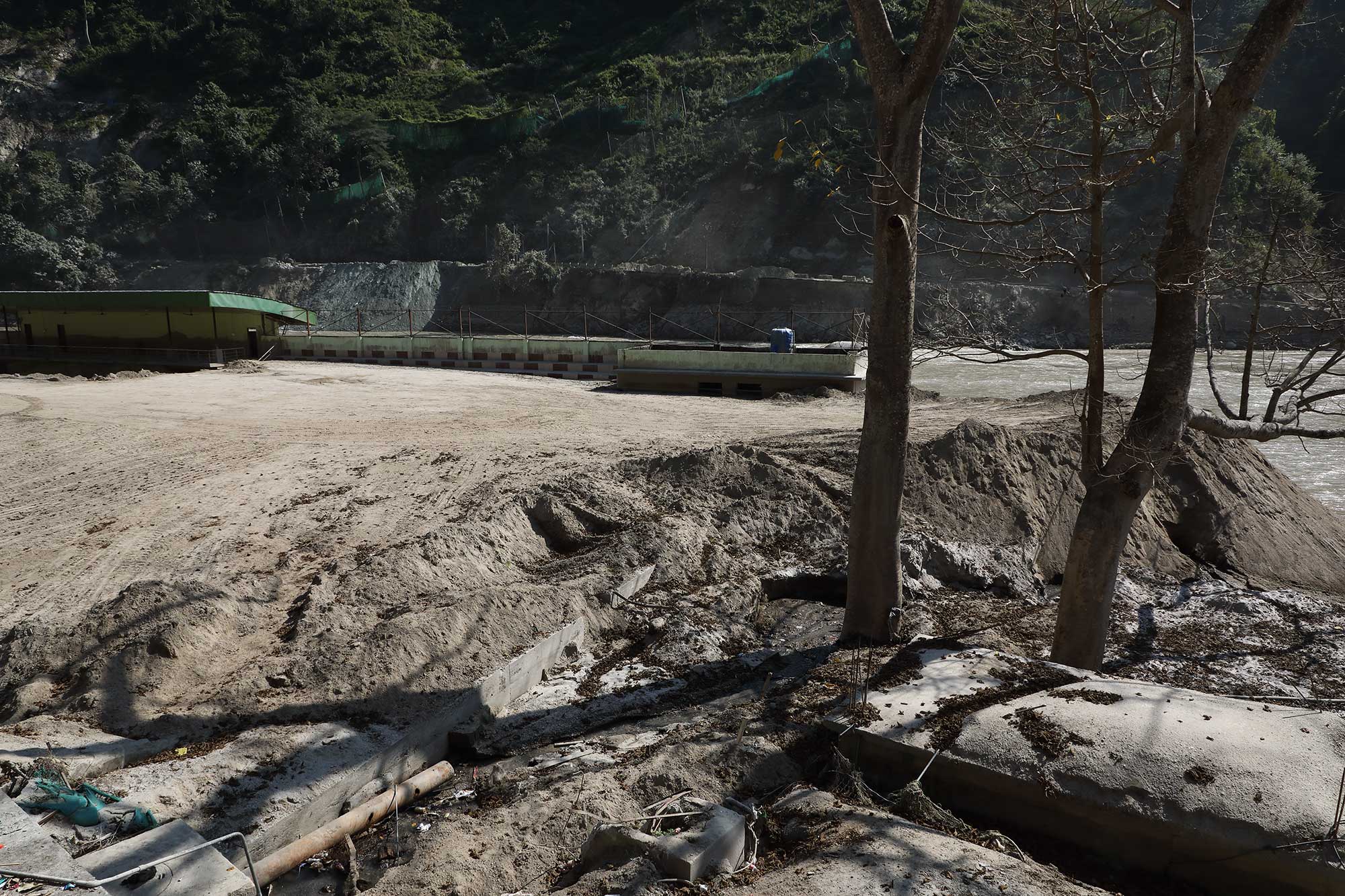
The Power Station (27 31 35.3 N 88 32 31.2 E) Elev 831.9m for the Sikkim Urja dam was also non functional and the bridge to the power station had been swept away by the GLOF. We saw a small band of workers on the opposite bank who had crossed over on a ropeway.

We stayed over night at Dzongu and started for Chungthang at 4.30am next morning. We will cover that in our next blogpost.

My thanks for all who helped.

Praful Rao
Kalimpong district
Darjeeling-Sikkim Himalaya
savethehills@gmail.com
9475033744
with
Praveen Chhetri
Junkeri Studios,
Kalimpong.
9733185815


Report and recommendations on the GLOF disaster which affected Teesta valley in Oct2023.

We, in the Darjeeling Himalaya Initiative (DHI) submitted a report (with recommendations)  to the NDMA and the SDMA’s of W Bengal and Sikkim based on our observations and interactions with affected people in the numerous visits to GLOF affected areas between 27th mile, Kalimpong District, W Bengal and Dikchu in Gangtok district, Sikkim more than a week ago. The reports were substantiated by the many posts and photographic records on the disaster made in the SaveTheHills blog.

Having visited some of the worst affected areas in North Sikkim between 17-19Nov2023, we can only reaffirm what has been reported:

  • We need an expert team to visit these areas and advise us the course of action to be taken in the limited time we have before the next monsoons.
  • That we should focus on building the resilience of communities in the flood affected areas while continuing with the recovery and reconstruction process, since many of our populated areas in the Teesta Valley in Sikkim and W Bengal will again be affected during the Monsoons 2024.
  • That time is of essence.
The full report is reproduced below:

Report and recommendations on Glacial Lake Outburst Flood (GLOF) affected areas between Dikchu (Sikkim) and Teesta Low Dam Project III (TLDP III, 27th mile), Kalimpong (West Bengal)

Report Drafted by SaveTheHills

Submitted by SaveTheHills and Darjeeling Himalaya Initiative
Reported areas are in RED circles

  • What we people living along the Teesta valley in parts of Sikkim and Kalimpong District of West Bengal, witnessed in the early hours of 04Oct2023 was a rare, dangerous and a huge catastrophe with the Glacial Lake Outburst Flood (GLOF) from South Lhonak Glacier, massive dam breach at Chungthang and subsequent floods causing loss of life and livelihoods and devastating large areas of the valley. The size and scale of the event has far escaped the appropriate attention of both the national and concerned state governments. It has been totally under reported by the mainstream media. Many of us, even from Darjeeling and Sikkim Himalaya have pushed it to distant memories and forgotten that there is massive work ahead with rehabilitation and mitigation.

  • When the very turbulent waters of the GLOF from South Lhonak glacier located at 17,300 feet above mean sea level crashed into the already brimming reservoir of the 1200MW Sikkim Urja Dam at Chungthang, the dam was quickly overwhelmed and burst, releasing a wall of water which was 10-15 feet high. This deluge swept through the Teesta valley, destroying everything in its 162 km rampage from the glacier to NHPC Teesta Low Dam Project (TLDP) III at 27th Mile in Kalimpong district.
  • This report is an attempt to preserve facts of this humongous event and to urge both government and civil society to recognize and respect the vulnerable fragility of the Himalaya. It is extremely apparent that there is the need to be prepared for more such disasters as the Himalaya gets warmer.
  • The fundamental recommendations stem from extensive field visits to GLOF affected regions and in-depth conversations with the affected residents. Having witnessed the profound impact of this catastrophic event on infrastructure and communities, it is crucial to recognize that we have a mere five-month window to initiate remedial actions. Our primary objective is to empower and ready the traumatized community to confront the challenges of the upcoming monsoon season in 2024, ensuring improved safety and resilience, and safer road networks for the thousands who transit each day.
  • We have not visited Chungthang and other affected areas in North Sikkim as yet, but have made several visits to GLOF affected areas between Dikchu and 27th Mile (Kalimpong district) and photo essays from our visits are placed in the STH blog http://savethehills.blogspot.com.
  • It is requested that this report be read in conjunction with more specific inputs from our photo essays in the STH blog which will amplify the observations that are made below.

    Teesta river in spate at the Teesta bridge, on 04Oct2023 (drone image)

Observations

The Teesta river 

  • The Teesta is still unusually large and fast for this time of year. As such it is continuously eroding sections of NH10 as well as low lying populated areas like the Teesta bazar.
  • The river level, post GLOF is much higher; undoubtedly due to the silt deposits as the river slows down in areas of less gradient. In this regard, Mr Lalitendu Tripathi, Executive Director, NHPC, (North Bengal and Sikkim) stated in an interview with a local TV channel ‘Himal World’ that the level of the whole Teesta Basin had increased by 3-4m due to the debris deposits.
  • Locals blame the huge silt deposits by the Teesta on the IRCON project and the tunnel excavations which were dumped on the river banks and which were swept away by the GLOF. To make matters worse, the sludge and sand that is being excavated from all areas as communities try to rehabilitate is being dumped back into the river or onto the river bank. This will undoubtedly increase the silting of the river and increase the river levels even further.
  • Many of the affected people interviewed stated the river was ‘far away and far lower’ before the GLOF event. As such, Teesta at many places is now flowing in the vicinity of populated areas, some of which are subsiding.
  • The amount of debris which has been brought down by the GLOF is phenomenal and besides tree trunks and branches which are visible and strewn all over the river banks, the invisible heavier debris would also include metal from the many bridges swept away, vehicles, boulders and parts of homes which must be buried deeper in the sand and also ammunition and explosives which make the task of clearing the debris risky.
  • The thickness of the silt/sludge deposits on the river bank, roads or burying homes is 10 feet or more.

Early warning mechanism

  • The media is fuzzy whether an AWS (Automatic Weather System) or a GLOF EWS (Early Warning System) was available in North Sikkim but whatever was installed, failed to work.

    What worked was a much more primitive system where alerts were sounded on bull horns, doors were banged, whistles blown and people informed on cell phones that ‘the river had become big’ and they should move to higher ground. At places the police force was very effective but in the end it was just people reaching out to each other, to their friends and relatives downstream which resulted in less casualties.
    All this took place when our entire region was being pelted by heavy rain, in pitch dark in the early morning hours on 04Oct2023. It was fortunate that the cell phone system worked otherwise there would have been far more fatalities.

Impact on communities and settlements


  • We talked to numerous GLOF affected people in Sikkim, as well as in Kalimpong district. Everyone unanimously said they were scared of living in their present homes and requested the government or political party to relocate them to a ‘safer place’.

  • Many homes in the shanty /slum areas were swept away by the GLOF (IBM colony – Rangpo, below the Melli bridge, at Teesta Bazar, Geil Khola and Bangay bazar.) Displaced residents from here are living in relief camps or with relatives in Kalimpong district (W. Bengal). Affected people from Sikkim were given compensation by the government on 26Oct2023and have returned home – relief camps in Sikkim have been closed.
  • Many of the RCC homes survived the floods but were buried under a 10-15 feet blanket of sand and sludge. The owners of these homes are excavating their homes and returning.
  • Some parts of Teesta bazar which are on the river bank are subsiding due to the erosion of the river which is now flowing very close to these areas.
  • Many buildings and homes adjoining the river banks have now been weakened with large cracks and their foundations eroded.
  • Many concrete homes (which were not washed away) are still submerged in water at places.

Impact on the roads, NH10 (Singtam to TLDP III section) and bridges

  • Parts of the Teesta to Darjeeling road was under water until 20Oct2023. This road and
    NH10 were opened for light vehicle traffic only and between 6am-6pm, on 21Oct2023.
  • Due to the restriction in heavy vehicles using NH10, all the heavy vehicle traffic from Sikkim and Kalimpong is now being routed thru the Lava - Gorubathan route. This is causing severe traffic jams in certain areas as well as disturbance to residents of Kalimpong, Pedong and Lava since the traffic is only allowed to operate at night. This route from Kalimpong to Siliguri is also much longer and takes 7 hours whereas the NH10 route only takes 3 hours Consequently, this detour directly affects the availability and cost of goods in Kalimpong and Sikkim.
  • With the river level much higher now, it flows almost at the same level as the Teesta – Darjeeling road.
  • When checked on 02Nov2023, parts of Teesta bazar – Tribeni road were still submerged under the Teesta river.
  • NH10 has been damaged severely at many low lying areas where the Teesta flows close to the road. In such areas, the edges of the road are cracked and the river continues to pull down chunks of the road making driving on this road a risky proposal (hence the timings for use of the road and restrictions on heavy vehicles). Examples of such areas on NH10 are

     - Directly opposite Melli bazar
- From Teesta bazar to Baluakhani (TLDP III) towards Siliguri.

  • While the 29th Mile landslide near Teesta bazar remained stable during the GLOF, a very old landslide which had been dormant for decades was activated at Likhu Bhir.
  • Many sections of NH10 are subsiding into the river.

  • Major bridges (in the area surveyed) which were destroyed by the GLOF were Indreni bridge linking Singtam with Adarsh gaon and NHPC bridge from Tar Khola to the Patel Engineering Complex in Sikkim.

 Condition of the dams and economic impact.

  • Sikkim – Urja dam Stage III has been destroyed.
  • The NHPC dam at Dikchu (Stage V) has also been severely damaged by the GLOF and as per the Executive Director (NHPC), Mr Lalitendu Tripathi it would take a year to restore operations.
  • NHPC Stage VI dam at Sirwani (Sikkim) had a huge amount of debris dumped into it and the under construction power station for this dam at Tar Khola (with Patel Eng.) was almost wiped out.
  • We do not know the condition of TLDP III fully. However, the 3-4m siltation deposit on the riverbed and repair of some damaged mechanical parts will prove a challenge here. Moreover, filling the reservoir will probably flood parts of Teesta bazar, the Teesta - Darjeeling road and the Teesta -Tribeni road.
  • As on date no major dam has been functioning in the Teesta valley from 04Oct2023, upto and including TLDP III.
  • The economic impact though not exactly known is huge and much of it is being claimed from insurance. The complete socio-ecological loss of the disaster is incomprehensible and not easily monetized.

Impact on areas not surveyed

  • Our surveys thus far have been confined to urban areas and accessible roads, limiting our assessment of the situation. The catastrophic impact of the GLOF plus dam burst is starkly evident in the extensive damage inflicted on forests, as millions of uprooted trees now litter the riverbanks.
  • The vulnerability of these remote, less-accessible areas needs to be assessed as we anticipate the upcoming monsoon season

Recommendations

1. Detailed Assessment of the GLOF impact and its future repercussion

An expert committee needs to be set up urgently to look into:

  • High river levels, likely flow pattern of the river and vulnerability of populated areas in the proximity of the river in the next monsoons.
  • Assessment of condition of NH10 and other roads in areas impacted by GLOF. As on date, many places between Likhu Bhir and 27th Mile and around Melli show signs of subsidence.
  • Alternate routes for heavy and light vehicles, timings for use of roads and traffic control in such areas need to be planned and informed to the public.
  • Vulnerability of sinking populated areas such as those in Teesta bazar and other places needs to be studied and mitigation methods such as protective embankments implemented.

2. Rehabilitation of affected homeless people

  • Rehabilitation is an extremely traumatic and distressing experience for people affected by disaster where they have to uproot themselves from their homes and relocate to a strange, different place and adapt to an entirely different environment.
  • The GLOF event has resulted in many people whose homes have been swept away and their place of residence has become too dangerous to live in and as such today temporarily live in relief camps or with relatives or in rented places. The number of such people will increase in the future as more areas get affected by the Teesta river.
  • Relocation of such people needs to be planned and looked into and safety, opportunities and well being factored into the rehabilitation process.

3. Strengthen preparedness

  • A fail safe Early Warning and Dissemination System needs to be provided in the vulnerable areas of Teesta Valley.This should be a system which will continue to function in a disaster scenario with severe power outages and damage to cell phone towers - which is likely to happen in a major disaster.
  • Manual hooters and other disaster alerting systems should have a distinct sound which cannot be confused with ambulance or other siren sounds.
  • The status of NH10 and other prominent roads must be informed to the public through social media or electronic sign boards at key places.
  • Relief centres in vulnerable areas should be planned in advance so that they could be set up rapidly in the event of a disaster. Solar lighting/ generators must be provided in such places.
  • The cell phone system in the Teesta valley played a crucial role in saving numerous lives and ensuring continuous communication with affected individuals during the recent disaster. However, given the susceptibility of this communication system to landslides and power outages, it is imperative to establish a resilient backup solution. Implementing ham radios as a back-up communication may be considered. These ham radios can be operated by ex-servicemen, who are already trained to operate such equipment.
  • Investment in power rescue tools, solar lighting, first aid training, home insurance, AWS (automatic weather stations), etc. all would be immensely helpful in building a more resilient community.

4. Capacity building and raising awareness.

  • Massive awareness campaign along with CBDRM needs to be implemented. Many lives were lost when people chose to ignore the warning issued either on the cell phone or in person.
  • Periodic evacuation drills need to be conducted in all vulnerable areas.
  • Capacity building for communities in the valley has to be a priority action. Their experiences of what worked during the disaster therefore needs to be strengthened. What were the gaps needs to be studied, improved and documented. Serious efforts must be made for working on the gaps in a time bound manner, with constant monitoring mechanisms put in place.
  • A ‘Lest we forget’ memorial can be made by preserving any of the structures that have been impacted by the floods. This can be developed into a good awareness and educational space for people to visit with interpretation material that consist of write ups / photographs / human stories on the event of October 4th 2023.

Conclusion

As has been stated already, the Oct2023 disaster is the most serious disaster to have affected the Darjeeling -Sikkim Himalaya after the October 1968 deluge. It has not received due attention because its greatest impact was confined to the Teesta valley that does not always take center stage. Also the number of fatalities was comparatively limited and disaster discourse does not fully acknowledge the socio-ecological importance of the mountains and the cumulative loss due to disasters. The impacts of the GLOF, dam breach and subsequent impacts on infrastructure and urban settlements cannot be understated and needs to be looked into with urgency and importance. Time is of essence, with the monsoons of 2024 just months away. We urge experts to visit and assess the situation and remedial action to be initiated without delay so that the impacts of this disaster do not continue into the coming monsoon.

Wednesday, November 15, 2023

Photographic record of the impact of 04Oct2023 GLOF at Melli bazar and its vicinity -13Nov2023


Melli (27 05 24.2 N 88 27 29.6 E) Elev 232.9m, is a place which straddles the Teesta river. In South Sikkim, it is a small town, whereas in W Bengal (Kalimpong district) it is a transit place on NH10, Kalimpong district ,W Bengal.
We visited Melli during our survey of Teesta bazar on 10Oct2023 but could not access Melli (Sikkim) because the road from the bridge to the Melli town was closed to traffic.
On 13Nov2023, more than a month after the GLOF event I could make it to Melli town (Sikkim) with Prof Malay Mukul (Dept of Earth Sciences, IIT Bombay). Malay is from Kalimpong and was on a brief vacation here. These are some images from our visit on 10Oct2023:
Drone image (by Praveen) of the Melli ground  and stadium with the Teesta river nudging the edges of the complex.
Shredded parts of NH10 with a view of Melli town (Sikkim) from the opposite bank.
An excavator had started removing sand and sludge from the stadium on 10Oct2023.

Images from our visit on 13Nov2023 to Melli.
A dumper at the Melli ground belonging to SML company had been excavated along with the first floor of the several buildings at the rear.
The wreckage of another vehicle lay at the edge of the Melli stadium. Excavation of the sand, debris and sludge was continuing but seemed a humongous task considering the almost 10-15feet of sand that was dumped everywhere. Prof Malay Mukul can be seen in the background taking some readings.
Another view of the Melli stadium with buried vehicles strewn all over. Notice how close the river had come to the main town during the GLOF. In the distance and across the river is the IRCON railway tunnel.
This was the area which was most affected in Melli town (Sikkim) by the GLOF event.
A sombre Milan Gurung (48yrs) stands at his home near the Melli stadium with the Teesta river lapping up the edges of what used to be his front yard. He told us that 3 new vehicles from SML company were swept away here along with a large liquor storehouse.
He squarely blames the inundation of his home on the dumping of excavated tunnel material on the opposite bank by the IRCON project. He says the river first hit the huge IRCON debris on the opposite bank and rebounded from it, to flood his home and 10 houses around the stadium.
Milan Gurung told us the river was never so close to his home earlier and was fearful about living here now.
Debris at the opposite end of the stadium.
Residents of this area said the sewage treatment plant of Melli town was located here and it was either swept away or buried.
Dangerously poised GLOF affected buildings on the W Bengal side of Melli Bazar.
The problem is that there are so many weakened structures like these, everywhere with the river nibbling away at the base.

Images of Tribeni (at the junction of Rangeet and Teesta rivers)

Image of the GTA Covid Hospital at Tribeni on 10Oct2023.
Image of the GTA Covid Hospital at Tribeni on 13Nov2023.
Rangeet river water is distinctly green whereas that of the Teesta is still laden with silt and brown.
Road to GTA Covid Hospital at Tribeni on 13Nov2023
A large section of road (approx 300m) from Teesta bazar  to the GTA Covid Hospital at Tribeni is still submerged - with the river having regained its lost territory.
The river submerges the road here (27 04 6.8 N 88 25 39.7 E) just 10 mins walk from the Teesta bazar. Sadly, this place has now become a dumping ground for solid waste.

The road remains under water for a long time until it reaches here (27 04 14.4 N 88 25 49.2 E) where it climbs out of the river.

My thanks to Prof Malay Mukul for taking time off to visit these places. I will update his inputs in a separate blogpost.

Praful Rao
Kalimpong district
Darjeeling-Sikkim Himalaya
savethehills@gmail.com
9475033744


Sunday, November 12, 2023

Cyclone Aila (26May2009) vs GLOF (04Oct2023) : Photos of Teesta river at Teesta Bazar

Cyclone AILA was a huge disaster event which impacted Darjeeling- Kalimpong districts between 24May and 26May2009 when it dumped 247mm of rain in Darjeeling in 24hrs. 17 people lost their lives in the storm. STH tracked the cyclone and has blogged extensively about it in May and June2009. (See 1, 2, 3).

In order to understand the magnitude of both these disaster events I have placed photos of the impact on the Teesta river, taken from approximately the same location on the Teesta bridge in May2009 and in Oct2023.

Photos of the Teesta river of 2009 were courtesy Mr Naren Tamang of Kalimpong TV and taken DURING the storm - please note no major dams were operating upstream in the Teesta valley then.

Photos of the GLOF event were taken by me on 10Oct2023, 6 days after the the GLOF event.

Cyclone AILA (26May2009): Photo of homes close to the river bank almost directly below the Teesta bridge. The Teesta - Darjeeling road is intact and was not touched by the river during Cyclone AILA.
GLOF (10Oct2023): Image of almost the same area, 6 days after the GLOF event. Note the level of the river vis-a-vis the level of Teesta -Darjeeling road.
Cyclone AILA (26May2009): Teesta river (looking north). No major dams were operating then and settlements of Teesta bazar near or on the bank were minimal.
GLOF (10Oct2023): Teesta river (looking north). Almost the same scene but 14 years later. Note the density of the settlements on the river bank - many such homes were swept away
Cyclone AILA (26May2009): Photo of Teesta from the bridge (looking south). The Teesta to Darjeeling road (extreme right) is considerably higher than the river and was not damaged by AILA.
GLOF (10Oct2023): Photo of Teesta from the bridge (looking south).The level of the Teesta is so much higher and parts of the Teesta to Darjeeling road are under water.

Praful Rao
Kalimpong district
Darjeeling-Sikkim Himalaya
savethehills@gmail.com
9475033744

Thanks to Naren bhai for the images of Cyclone AILA