Showing posts with label fatal landslides. Show all posts

Tuesday, June 16, 2020

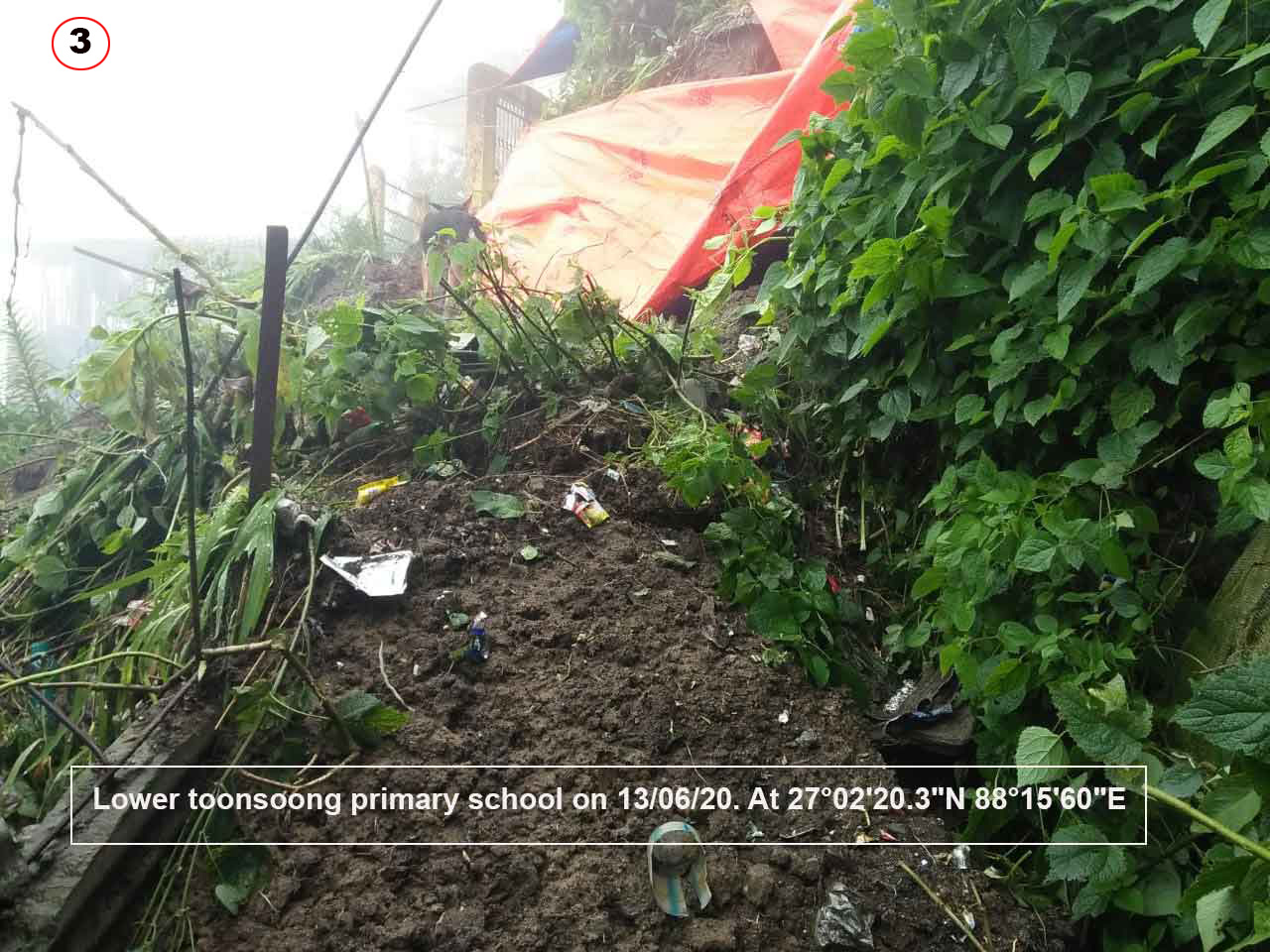
The landslides of Darjeeling town (13Jun2020) - human factor also a trigger?

The SW monsoons finally arrived over the Darjeeling - Sikkim Himalaya on 12Jun2020.
Darjeeling town, received 105mm of rain over a approx 36 hour period, most of it coming down on 12Jun in intense bursts. Between 11-13Jun, Kurseong clocked an astounding 299 mm of rain and this not unusual since our experience shows that Kurseong certainly receives some of the heaviest rainfall in the region.
Six of the landslides which took place within the Municipal Limits of Darjeeling are shown in the map:-
Coordinates of these landslides and two others which are known to have taken place at Kurseong and Mungpoo are given below:-

Images of the landslides at Mungpoo and Sivitar T.E, Kurseong are placed below:-

Rainfall data of 2020 for our region is placed below:-
From the rainfall data it is very evident that, except for Gangtok ie East and North Sikkim, the whole region has been deficient in rainfall not only in 2020 but from the end of the monsoon season in 2019. As such I wonder how 6 landslips (small landslides) were triggered by the first burst of heavy rain (109mm) in Darjeeling town?
It is not abnormal to receive 100mm of rain over a 24hr period during the monsoons, what is abnormal is that this rain coming after a prolonged dry period caused so many landslips in Darjeeling town.
Each of those slope failures were capable of taking human life and our experience over the years has been that it is these small landslides in an urban setting which cause most of the fatal landslides. Saying so, I am painfully reminded of a fatal landslide barely 5 mins walk from my home in Jun2010, at Tirpai Kalimpong when it rained only 45mm overnight. It snuffed out the lives of a young mother and her 2 school going children.
In saying so, I must point out that occurring in densely populated urban settings, the trigger for the  landslide always has a human component and in most cases it boils down to managing our drainage system well. The high volumes of surface runoff from the intense rain in our towns must be drained away quickly and safely - otherwise they are bound to do mischief.

Praful Rao,
Kalimpong district
Darjeeling-Sikkim Himalaya


Saturday, April 23, 2016

First fatal landslide in the Himalayas (2016) : 18 deaths in Tawang, Arunachal Pradesh (21-23Apr2016)


Rainfall data of Tawang (16-22Apr2016)
16Apr2016 - 9mm
17Apr2016 - 4mm
18Apr2016 - 72mm
19Apr2016 -  8mm
20Apr2016 - 76mm
21Apr2016 - 70mm
22Apr2016 - 83mm
(Source : imdaws.com)
Excerpt from Arunachal TImes
TAWANG, Apr 22: Landslide triggered by heavy rain washed out an entire labour camp killing 16 people at Famla village in Tawang. One out of the 16 dead succumbed to injury on his way to hospital, while three narrowly escaped death.
Famla is located 2 km from Tawang headquarters.
The mishap occurred at around 3.30 AM on Friday when the SP type building where the labourers were putting up was hit by the slide caused due to torrential rain.
District police, Indian Army and local public of Tawang under took rescue operation which lasted for about 8 hours.
“Family members of the deceased have been informed about the accident”, said one of the survivors.
The laborers were mostly from Assam and Nepal.
(Read full story here)
Comment
Well, the pre-monsoon season has literally opened up with a bang!
Sixteen people dead 2days ago and 2 more dying today (as per NDTV) in rain triggered landslides in Tawang, Arunchal Pradesh, India.
What is scary is that the rains which caused these landslides were not the result of any major weather system - the SW monsoon is still a month away and in 2016 it is expected to bring heavier than normal rains (see previous blog).


Praful Rao,
Kalimpong,
Dist Darjeeling

Thursday, January 14, 2016

Images from a fatal landslide in the Darjeeling - Sikkim Himalaya (14Jan2016)

Most, if not all landslides in the Darjeeling-Sikkim Himalaya are triggered by intense rainfall, as such I was surprised to be informed by a friend early this morning of a landslide at Bhotey Bhir, near Rangpo, when it has been bone dry all winter.
Rangpo is on NH10, just an hour's drive from my home in Kalimpong and the landslide had occurred on National Highway10 (formerly NH31A)  at approx 05.00AM IST after the BRO's heavy earth moving machinery had finished doing its work of widening the NH10. I was informed at that 4 vehicles were buried in the slide but there had been only one fatality.
Placed below are images of the area when I visited the scene of the landslide area.
The landslide (coordinates 27°09’49.6” N 088°31’55.5” E, elevation 286m)on Google Earth.
Long queues on NH10 as they await clearance of the landslide.
Close-up of the area with a vehicle stuck in the landslide.
Anxious onlookers at the scene of the landslide, awaiting news...
The trucker who survived - the driver of a truck which was caught in the slide but managed to escape.
And the one who did not - a lone fatality and the body of a driver of another truck is brought down from the slide area by volunteers.
Debris removal and search operations continue at the landslide site
View of landslide from opposite bank of the Teesta (one can judge the size of the landslide with reference to that of the truck)


While there are many major landslide zones in the Sikkim-Darjeeling Himalaya (and I am sure in the entire Himalayas as well), our experience has been that fatal landslides are increasingly occurring in areas outside these zones and the characteristic of these landslides are typically :-
a. They are small landslides (like today's landslide in Rangpo)
b. Though rainfall may have been a trigger, there is also a large human footprint in the cause of the landslide.
c. They occur randomly, in dense urban settings, in villages and so on and as such are difficult to predict or set up EW machinery.
d. Since human activity (such as unplanned development) is a trigger in these landslides, much can be done to control, manage and mitigate this type of fatal landslides - it is a different matter that nothing is being done.
e. They will therefore continue to cause fatalities.
You can read the media report here

Update on the above landslide
a. As per media reports the death toll in the above tragedy now stands at two with a second person succumbing to the injuries sustained.
b. Also, there were 5 vehicles buried in the debris and not 4, as earlier stated.
c. NH10 was declared open by the BRO at 1837hrs on 15Jan2016.

Praful Rao,
Kalimpong,
Dist Darjeeling

Friday, July 17, 2015

Landslides in Kalimpong - A pictoral report (July2015)


On 30Jun/01July2015 torrential rains lashed Kalimpong dumping 227mm of rain in a 8hr period. This triggered numerous landslides both within the municipal limits and in the sub-division. STH did a survey of some of the affected areas which are indicated on the map above. Images from the areas are placed below.

As per the GSI, the Darjeeling- Sikkim Himalaya is one of the most landslide prone areas in the country and as per Dr David Petley, this area also is one of the global hotspots for fatal landslides.
SaveTheHills (STH) has, in this blog, over the years tried to maintain a historical record of this disaster form which has not received due recognition the world over so as to offer undeniable proof of a scourge which is growing worse in this region as human interference in the mountains increases.
In July2015, after 3 yrs of low landslide activity, we are witnessing a spurt in the number of landslides in Darjeeling district (esp in Kalimpong and Mirik) due to erratic and intense rainfall.
Rainfall records for Kalimpong and this region are placed here ( 1 and 2 ).
What is also clear is almost all the fatalities especially in urban or semi-urban settings are the result of poor or non-existent drainage.
While we have tried to cover many areas of the sub-division in our survey, large areas remain uncharted due to lack of resources and what is shown above is only the tip of the iceberg. (Major landslide areas south of the river Relli have not been included in our survey.)
GPS co-ordinates of all landslide listed are placed below:-


Placemark  Latitude
Longitude
1
 27° 4'40.69"N  88°28'57.54"E
2
 27° 4'57.11"N  88°29'13.31"E
3
 27° 5'6.11"N  88°29'24.97"E
4
 27° 4'23.12"N  88°27'17.35"E
5
 27° 3'28.51"N  88°26'45.02"E
6
 27° 3'59.18"N  88°28'25.21"E
7
 27° 2'50.46"N  88°28'52.10"E
8
 27° 4'23.45"N  88°29'18.64"E
9
 27° 3'4.14"N  88°26'33.45"E
10
 27° 4'8.12"N  88°29'38.10"E
11
 27° 2'42.50"N  88°39'4.80"E
12
 27° 5'13.50"N  88°39'41.10"E
13
 27° 5'59.00"N  88°40'56.60"E
14
 27° 6'16.50"N  88°40'48.40"E
15
 27° 4'10.20"N  88°38'1.70"E
16
 26°57'42.60"N 88°41'56.00"E
17
 27° 3'8.72"N  88°39'19.75"E
18
 27° 9'34.50"N  88°38'12.50"E


Praful Rao,
Kalimpong,
Dist Darjeeling

Sunday, July 5, 2015

Images from Limbu Gaon : Mirik (Kurseong sub-division, Darjeeling)


As per authorities in Ting Ling Tea Estate (T.E), in Mirik they received 13" (330mm) of rainfall between 30Jun and 01Jul2015 and having measured 8.8" (224mm) of rainfall in my Symon's rainfall gauge at Kalimpong for the same period I find that phenomenal amount of rainfall in Mirik wholly believable. As per the authorities I spoke to, 19 deaths are confirmed at Limbu Gaon in the T.E, with 20 casualties being rescued.
The images above of NDRF and other para-military persons taking part in searching for the dead in the landslides were sent to me by Arvind Subba, a young volunteer who is himself taking part in the relief operations there.

Praful Rao,
Kalimpong,
Dist Darjeeling


Wednesday, July 1, 2015

01Jul2015 : 226mm of torrential rain over a 6 hr period in Darjeeling district

For a hellish 6 hr period Darjeeling district especially Kalimpong was pummeled by torrents of rain starting from approximately 2000hrs.
I watched the clouding as it formed over us and remained almost stationery much like the clouding over Uttarakhand in 2013. Kalimpong received almost half (226mm)the entire July month's average rainfall (548.7mm) in the 6hrs and it is confirmed that that there have been at least 6 deaths in Kalimpong, numerous landslides and all the road links from Kalimpong to Siliguri are now cut off by slides.
The worst part is we have at least 3 months of rainfall ahead.

Praful Rao,
Kalimpong,
Dist Darjeeling


Tuesday, May 26, 2015

April 2015 Rainfall Data and the relationship of Fatal Landslides to Rainfall (SW Monsoons)


With the monsoons just around the corner, I thought it pertinent to post two graphs; the centre one is from Dr David Petley's recent blog on the 'Timing of the Landslide Season in Nepal'. The lower graph is from here
Though the graphs are for Nepal and Darjeeling, they undoubtedly highlight the relationship of rainfall to fatal landslides in the Himalayas.

Praful Rao,
Kalimpong,
Dist Darjeeling