STH has blogged about water scarcity in the rural areas earlier (kindly read 1) and we have a reference to Spring Shed rejuvenation program which was tried out in Kalimpong.
Praful Rao
Kalimpong district
Darjeeling -Sikkim Himalaya
SaveTheHills(STH) is a group of concerned citizens who are raising awareness about landslides in Darjeeling-Sikkim Himalaya. Many landslides are the direct or indirect result of human interference and preventable if sufficient care is taken. As such, unless we begin a comprehensive and sustained program towards landslide management, prevention and mitigation, the consequences of ignoring years of human callousness will, in the future be devastating.
Showing posts with label drying springs. Show all posts
Wednesday, April 12, 2023
Water shortage in the Third Pole: Bhalukhop Village, Kalimpong
Friday, September 18, 2020
A picture which is our shame : a spring in Kalimpong
As is known, springs all over the Himalayas are fast drying up and I have been involved in several attempts to rejuvenate springs in Kalimpong in the past (see 1 and 2).
It is therefore shocking to see the condition of many of springs from which so many draw their drinking water, this is just one example.
Praful Rao,
Kalimpong district
Darjeeling Sikkim Himalayas
Saturday, September 14, 2019
STH Activities: Working on Mountain Spring Rejuvenation with ICIMOD (&TMI) in Kalimpong - 13Sep2019
Excerpt from NITI Ayog's 'Inventory and Revival of Springs in the Himalayas for Water Security'
'Mountain springs are the primary source of water for rural households in the Himalayan region. For many people, springs are the sole source of water. For example, a major proportion of drinking water supply in the mountainous parts of Uttarakhand is spring based, while in Meghalaya all villages in the State use
springs for drinking, irrigation and for livestock. As per a rough estimate, there are five million springs across India, out of which nearly 3 million are in the IHR alone. Despite the key role that they play, springs have not received their due attention and many are drying up. Spring discharge is reported to be declining due to increased water demand, land use change, and ecological degradation. With climate change and rising temperatures, rise in rainfall intensity and reduction in its temporal spread, and a marked decline in winter rain, the problem of dying springs is being increasingly felt across the Indian Himalayan Region...
Of late, efforts to preserve and save springs from drying up and efforts to recharge them are gaining momentum....'
Praful Rao
Kalimpong District,
Darjeeling-Sikkim Himalaya
'Mountain springs are the primary source of water for rural households in the Himalayan region. For many people, springs are the sole source of water. For example, a major proportion of drinking water supply in the mountainous parts of Uttarakhand is spring based, while in Meghalaya all villages in the State use
springs for drinking, irrigation and for livestock. As per a rough estimate, there are five million springs across India, out of which nearly 3 million are in the IHR alone. Despite the key role that they play, springs have not received their due attention and many are drying up. Spring discharge is reported to be declining due to increased water demand, land use change, and ecological degradation. With climate change and rising temperatures, rise in rainfall intensity and reduction in its temporal spread, and a marked decline in winter rain, the problem of dying springs is being increasingly felt across the Indian Himalayan Region...
Of late, efforts to preserve and save springs from drying up and efforts to recharge them are gaining momentum....'
Praful Rao
Kalimpong District,
Darjeeling-Sikkim Himalaya
Friday, July 5, 2019
STH activities: Working to revive our dying springs in the Himalayas
ICIMOD along with The Mountain Institute - TMI (Gangtok) has carried out a detailed survey of several springs in the CHIBO -PASHYOR area with a view to carry out intervention on the same lines as the DHARA VIKAS program in Sikkim during the monsoon of 2019.
The above meetings were held as a precursor to the actual work on the ground.
STH is the local partner in Kalimpong.
Praful Rao
Kalimpong district
Darjeeling -Sikkim Himalayas
The above meetings were held as a precursor to the actual work on the ground.
STH is the local partner in Kalimpong.
Praful Rao
Kalimpong district
Darjeeling -Sikkim Himalayas
Labels:
aquifers,
climate change,
drying springs,
himalayas,
human impact,
ICIMOD,
kalimpong,
rejuvenating springs,
STH,
TMI,
water scarcity
Location:
Kalimpong, West Bengal, India
Saturday, June 29, 2019
An event of Note : Dialogue on Rejuvenation of Himalayan Springs : Kalimpong Park Hotel, 02Jul2019 at 0930hrs
If any news is dominating these days in India, it is water or its shortage thereof and the Indian Himalayas despite being 'the Third Pole' is not far behind the rest of the country in this regard.
It is well known that mountain springs which are our life line have been drying up at an alarming rate all along the IHR.
The above project undertaken between ICIMOD and The Mountain Institute (Gangtok) is the first intervention in Kalimpong even though several other organizations have also been working in the rejuvenation of springs in the Darjeeling-Kalimpong districts and the stakeholders dialogue on 02Jul2019 is in regard meant to put all on an even keel about what is being attempted, where and the work involved.
Praful Rao,
Kalimpong district
Darjeeling- Sikkim HImalaya
Labels:
drying springs,
himalayas,
ICIMOD,
impact farming,
recharging springs,
rejuvenation,
STH,
third pole,
TMI,
water crisis,
water shortage
Location:
Kalimpong, West Bengal, India
Thursday, February 22, 2018
Events of Note : Workshop on 'State of the Cryosphere in the Himalayas' (19/20Feb2018) and forthcoming workshop on Springshed Management (16/17Mar2018) at Gangtok, Sikkim
You can read a press statement about the Cryosphere seminar here.
Water or the lack of it is perhaps one of the most important issues for us who live in the Himalayas. As such ACWADAM's forth coming 2 day workshop on conserving our springs should be of interest to all of us.
Praful Rao
Kalimpong district
Darjeeling Sikkim Himalaya
Water or the lack of it is perhaps one of the most important issues for us who live in the Himalayas. As such ACWADAM's forth coming 2 day workshop on conserving our springs should be of interest to all of us.
Praful Rao
Kalimpong district
Darjeeling Sikkim Himalaya
Labels:
ACWADAM,
climate change,
drying springs,
Gangtok,
glaciers,
GLOF,
receding,
springs,
springshed management,
state of Himalayan cryosphere,
workshop
Location:
Gangtok, Sikkim, India
Thursday, June 16, 2016
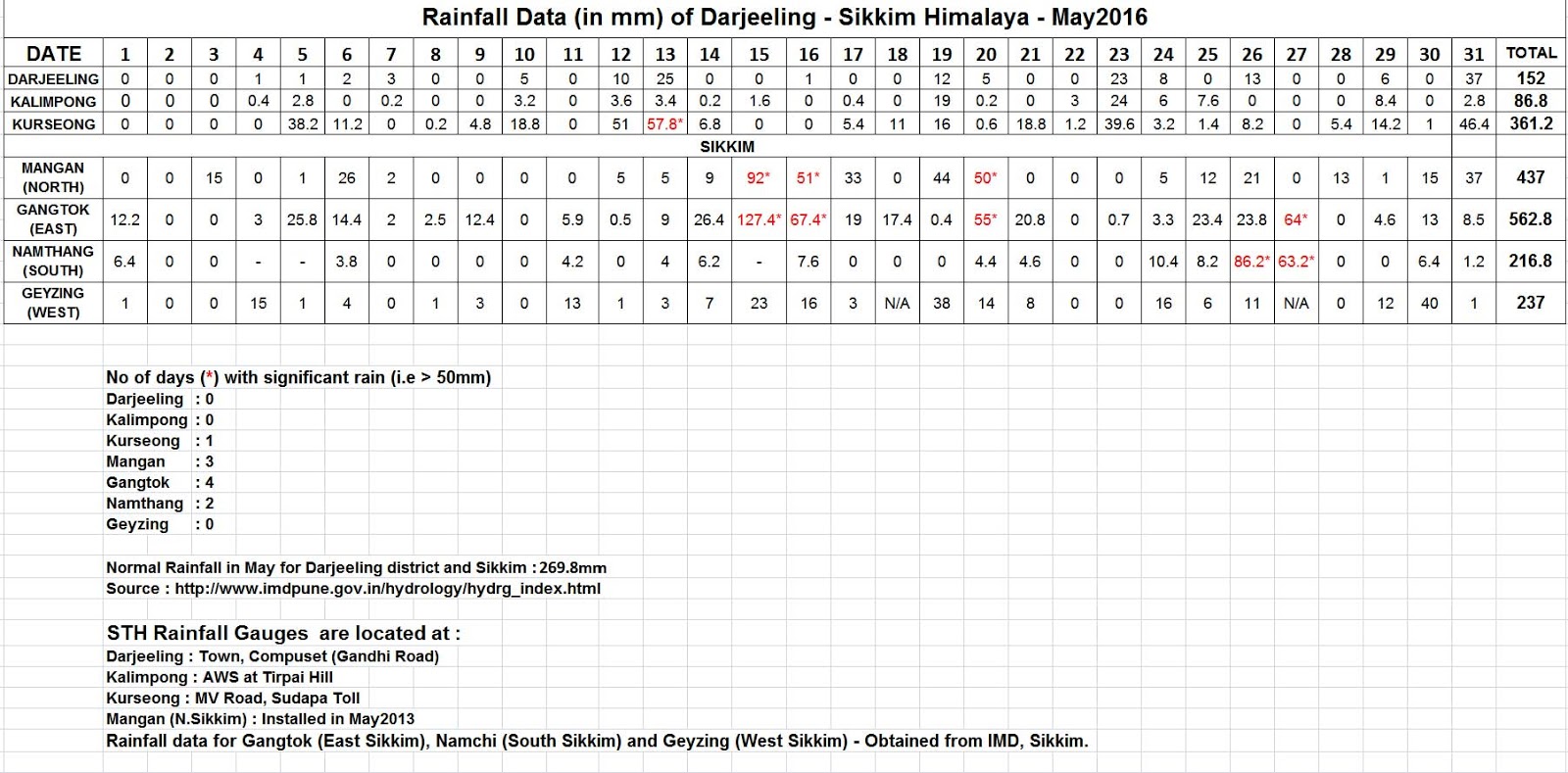
Rainfall data for Darjeeling-Sikkim Himalaya for May2016 and a sure way to kill our mountains
Much of Darjeeling district went deficient in rainfall in May2016 whereas in Sikkim, there was abundant rain.
Richu bridge in North Sikkim was washed away following the intense rains of 15/16May2016 and that proved to be an unexpected bonanza for hoteliers in Kalimpong with tourists changing their destination from North Sikkim to spend some time in Kalimpong.
Kalimpong was almost bone dry and desperate people started drilling the mountain aquifers to pump out water.
A study done in 2012 by a local NGO, revealed no shortage of surface water for Kalimpong town; the real reason for this shortfall only being mismanagement and corruption.
As such there is no requirement for drilling bore wells in Kalimpong in the first place.
Therefore, STH went on local TV and appealed through the press not to tamper with ground water without a thorough study of our aquifer system and also without plans to recharge drying springs.
So far this appeal has only fallen on deaf ears with the GTA announcing that it plans to dig another 10 bore wells in Darjeeling district.
Photo credit : Chinlop Fudong
Rainfall data collection : Rohan Rao, STH
Praful Rao,
Kalimpong,
Dist Darjeeling
Saturday, June 11, 2016
Mechanical extraction of water by drilling in Kalimpong : The need for caution (Interview in KalimpongTv)
Water security in the Himalayas will in the future be a humongous problem with documented information that springs which are our life line for water in the mountains, drying up at an alarming rate. Even a cursory check carried out by STH in and around Kalimpong revealed that many perennial springs had become seasonal and many seasonal ones had dried up. The reasons are many, one of them being the changing rainfall patterns which now gives us 5 months of abundant rainfall followed by almost 7 months of drought.
This in turn has led to a severe water crisis in the town with some desperate people turning to drilling for water within the Kalimpong town municipal limits.
STH along with a group of people had voiced our concerns on the drilling because:-
a. The extraction was being done without a proper study of the aquifer system and unregulated extraction of water at the crest could adversely affect downstream communities.
b. There was no mechanism in place to regulate the number of bore wells or the amount of water that could be extracted.
c. There was no word on recharging the aquifer system/springs or the need to protect recharge areas.
d. There was no word on testing the quality of water.
Kalimpong TV asked me for an interview regarding extraction of ground water in Kalimpong. The same is place below (sorry, the interview is mostly in Nepali)
Praful Rao,
Kalimpong,
Dist Darjeeling
This in turn has led to a severe water crisis in the town with some desperate people turning to drilling for water within the Kalimpong town municipal limits.
STH along with a group of people had voiced our concerns on the drilling because:-
a. The extraction was being done without a proper study of the aquifer system and unregulated extraction of water at the crest could adversely affect downstream communities.
b. There was no mechanism in place to regulate the number of bore wells or the amount of water that could be extracted.
c. There was no word on recharging the aquifer system/springs or the need to protect recharge areas.
d. There was no word on testing the quality of water.
Kalimpong TV asked me for an interview regarding extraction of ground water in Kalimpong. The same is place below (sorry, the interview is mostly in Nepali)
Praful Rao,
Kalimpong,
Dist Darjeeling
Saturday, April 19, 2014
A short film on water issues in Kalimpong.
Rohan Rao,
Secretary,STH,
Kalimpong,
Dist-Darjeeling,
Email - sth.secretary@gmail.com
Thursday, August 16, 2012
The good and bad news : El Nino is around.
It is now official that El Nino conditions will prevail over the the northern hemisphere at least until Nov2012 and it is widely speculated that this will lead to a shortfall in rainfall in India even as the south westerly monsoon slowly withdraws from the sub-continent.
Whereas this maybe good news as regards landslides in this region (we had no major landslides or casualties except for the Tindharia and Pagla Jhora slides), I shudder to think of what it portends for our drinking water and power situation in the summer of 2013 (not to mention impact on agri/horticulture over the winter months etc).
Praful Rao

Created by: www.OnlineAssociatesDegree.com
Subscribe to:
Posts (Atom)